What Is Term Life Insurance? A Complete U.S. Guide


Contents
Most of us insure the things that would be expensive to replace. We cover the car, the phone, the house. Term life insurance applies that same logic to the one thing no policy can actually replace: the income and stability you provide for the people who depend on you. If something happened to you tomorrow, term life is what keeps the mortgage paid, the lights on, and your family's plans intact.
It is also the most straightforward and affordable way to buy that protection. You pick an amount of coverage and a number of years, you pay a set monthly premium, and if you pass away during that window, your beneficiaries receive a lump sum that is generally free of federal income tax. There is no investment account to manage and no complicated fine print about cash value. That simplicity is exactly why term life is the coverage most American families start with.
What this guide covers
- What term life insurance is and how it actually works
- The main types of term policies you will run into
- How term life compares to whole life and other permanent coverage
- Who term life is really for, and how to size and time your coverage
- How underwriting works, including no-exam options
- Riders, living benefits, and the tax treatment of a payout
- Common myths worth clearing up
- How Eleos fits in
What is term life insurance?
Term life insurance provides protection for a set period of time, called the term. As the National Association of Insurance Commissioners (NAIC), the standard-setting body for state insurance regulators, puts it, term life is "a policy that is purchased for a period of time (a term)" that "pays money to the named beneficiaries if the insured dies during the term." It is "intended to provide lower-cost coverage for a specific period, like a ten year or 20-year period."
How the mechanics work
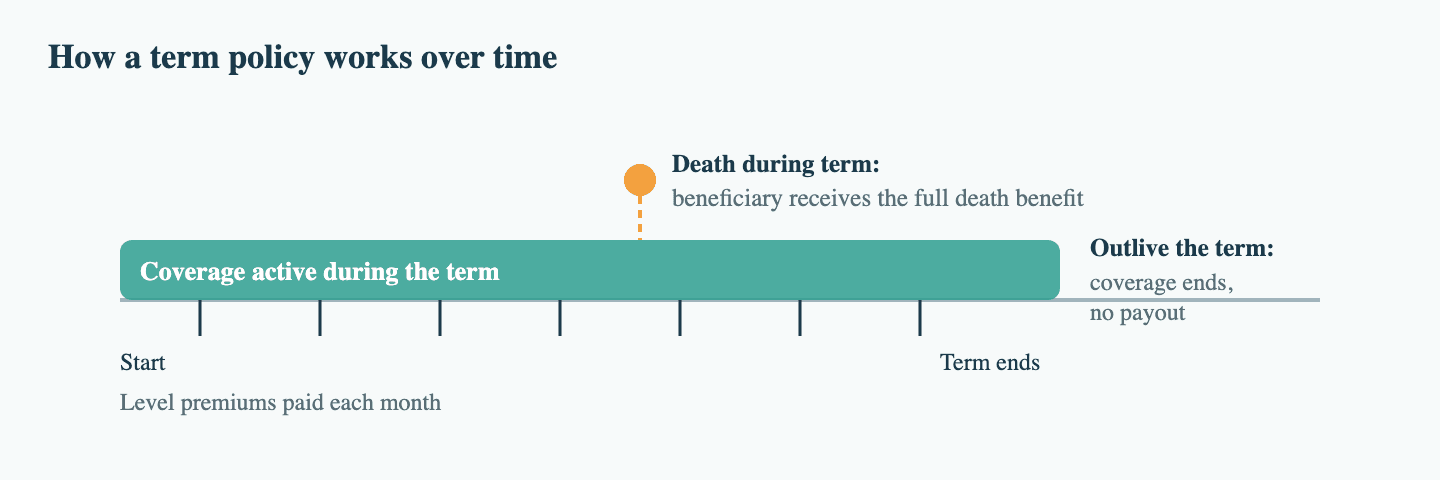
The mechanics are simple. You pay a premium, usually monthly, to keep the policy in force. If you die while the coverage is active, the insurer pays your named beneficiary the death benefit, which is the coverage amount listed on the first page of the policy. If you outlive the term, the coverage simply ends. There is no payout, in the same way there is no refund on the years of auto insurance during which you never filed a claim.
Two features that define term life
It is temporary
Common terms run 10, 15, 20, or 30 years, or in some cases to a specific age. You match the length to a need that has a natural end date, such as the years left on a mortgage or the time until your youngest child is grown.
It has no cash value
Guardian describes term life as "sometimes called 'pure life insurance' because unlike whole life insurance, the policy has no cash value component — it's designed purely to give your beneficiaries a payout if you pass away during the term." Every premium dollar goes toward the protection itself, which is precisely why term costs so much less than permanent coverage for the same death benefit.
Types of term life insurance
Term life sounds like one product, but insurers offer a few variations. Knowing the differences helps you read a quote and choose the right structure.
Level term
Level term is the version most people buy. Both the death benefit and the premium stay the same for the entire term. Guardian calls it "the simplest, most common type of policy," because "your premium stays the same for the entire term." You lock in a rate at your current age and health, and it does not move for 20 or 30 years.
Annual renewable term
Annual renewable term, sometimes called yearly renewable term, covers you a year at a time with an option to renew without a new medical exam. It starts cheap but the premium climbs every year as you age, so it is best for short, uncertain gaps rather than long-term protection.
Renewable term
Renewable term more broadly lets you continue coverage at the end of the term without proving insurability again, though the new premium is based on your older age and generally jumps sharply. This preserves coverage but not the low price.
Convertible term
Convertible term lets you exchange the policy for permanent coverage without a new medical exam. Many level term policies include this feature, but the conversion window is usually limited and varies by insurer, so check the deadline rather than assuming you have until the end of the term. Guardian, for example, lets you convert level term coverage to a permanent policy "at any point in the first five years," and "you won't have to get a new medical exam." Conversion is a useful safety valve if your health changes and you decide you want lifelong coverage.
Decreasing term
Decreasing term starts at a set death benefit that shrinks over the years and reaches zero at expiration. It is often paired with a mortgage, since the payout falls roughly in step with the shrinking loan balance. Level term has largely replaced it for general use, but you may still see it as mortgage protection.
Return of premium
Return of premium is an add-on that pays back all or part of the premiums you paid if you outlive the term. It sounds appealing, but the refund is money you funded yourself through a much higher premium. Guardian notes that premiums on a return of premium policy "could be 2-5 times higher than a level term policy." Weigh that against simply buying plain term and investing the difference.
Term life vs. permanent life insurance
The biggest fork in the road when buying life insurance is term versus permanent. Permanent coverage, most commonly whole life, is built to last your entire lifetime and includes a cash value account that grows over time. The NAIC notes that with a cash value policy "you can keep it for as long as you need it," and that these policies "have savings or investment features, which make it possible for policy owners to get money from the policy while they're still alive." Term, by contrast, is protection only, for a set stretch of years.
The cost difference
That structural difference shows up most dramatically in price. Because term has no savings component, it delivers far more death benefit per dollar.
Guardian's published 2025 rate tables make the gap concrete. For a healthy, non-smoking 40-year-old buying $500,000 of coverage:
- 20-year term runs about $34.50 a month for men and $35.27 for women
- Whole life runs about $6,387 a year for men (roughly $532 a month) and $5,860 for women (roughly $488 a month)
That is roughly fourteen to fifteen times the cost for the identical death benefit at that age. The gap is similar at younger ages: at 30, the same $500,000 costs about $28 a month as 20-year term for men and $23.50 for women, versus roughly $359 and $330 a month respectively for whole life.
A note on these figures. Guardian publishes rate data on several pages and the numbers do not always agree. The figures above come from Guardian's dedicated term and whole life rate tables, which cite Covr Financial Technologies data valid as of February 27, 2025. Guardian's separate term-versus-whole comparison page shows different numbers for a 40-year-old, and its $28 term figure matches the age-30 rate in the dedicated table. Rates are illustrative in any case; your own quote will depend on your age, health, and the insurer.

When permanent coverage makes sense
None of this makes permanent insurance a bad product. Whole life suits specific goals, such as lifelong coverage for a dependent who will always need support, estate planning, or a tax-deferred place to build cash value after other retirement accounts are maxed out. But for the most common reason people buy life insurance, which is protecting a family during the working, mortgage-paying, child-raising years, term gives you the coverage you need at a price that fits a real budget. The right question is not which product is better in the abstract, but which one matches your need and how long that need will last.
Who needs term life insurance?
Term life earns its keep whenever someone else would feel the financial impact of losing you.
Common reasons to buy
The most common reasons families buy it include:
- Replacing lost income. If a partner, children, or aging parents rely on what you earn, a death benefit can stand in for years of paychecks so they are not forced to change everything at once.
- Paying off the mortgage. Coverage sized to your loan balance can keep your family in the home instead of having to sell it under pressure.
- Covering other debts. Co-signed loans, private student loans, and car loans do not always disappear when you die. Insurance can settle them so the balance does not land on someone you love.
- Funding your children's future. A benefit can cover childcare, keep a stay-at-home arrangement viable, or fund college tuition down the road.
- Protecting a business. Owners use term coverage to fund a buy-sell agreement or to protect against the loss of a key person.
- Final expenses. A funeral and related costs often run into the thousands, and few families want that bill arriving with their grief.
When you might not need it yet
If no one depends on you financially and you have no debts that would pass to others, you may not need much coverage yet. But needs tend to arrive faster than people expect. A marriage, a first home, or a first child can turn "I'll deal with it later" into "I wish I had locked in a rate when I was younger and healthier," since term premiums are largely built on your age and health at the time you apply.
How much coverage, and for how long?
Two decisions shape a term policy: the amount and the length. Both should trace back to the specific job you want the money to do.
Choosing the amount: the DIME method
For the amount, a widely used starting point is the DIME method, which totals four things:
- Debts: credit cards, car loans, personal or business loans
- Income: the years of income your family would need to stay stable, often set at a multiple of your salary
- Mortgage: the remaining balance on your home
- Education: expected future tuition for your children
Add those up, subtract savings and any existing coverage, and you have a grounded estimate rather than a guess. It also helps to talk with the people who would actually receive the money about how many years of support they would need.
Choosing the term length
For the length, match the term to the horizon of the need. If you have 22 years left on a mortgage and a toddler at home, a 25-year or 30-year term covers both the loan and the years until your child is independent. If your main concern is a business loan due in a decade, a 10-year term may be all you need. Buying a longer term than the need requires, or a lifetime policy for a time-limited job, usually just costs more than it should.
How underwriting works
Underwriting is how an insurer decides whether to offer you coverage and at what price. It is worth understanding, because it explains why two people the same age can pay very different premiums, and why honesty on the application matters so much.
The application
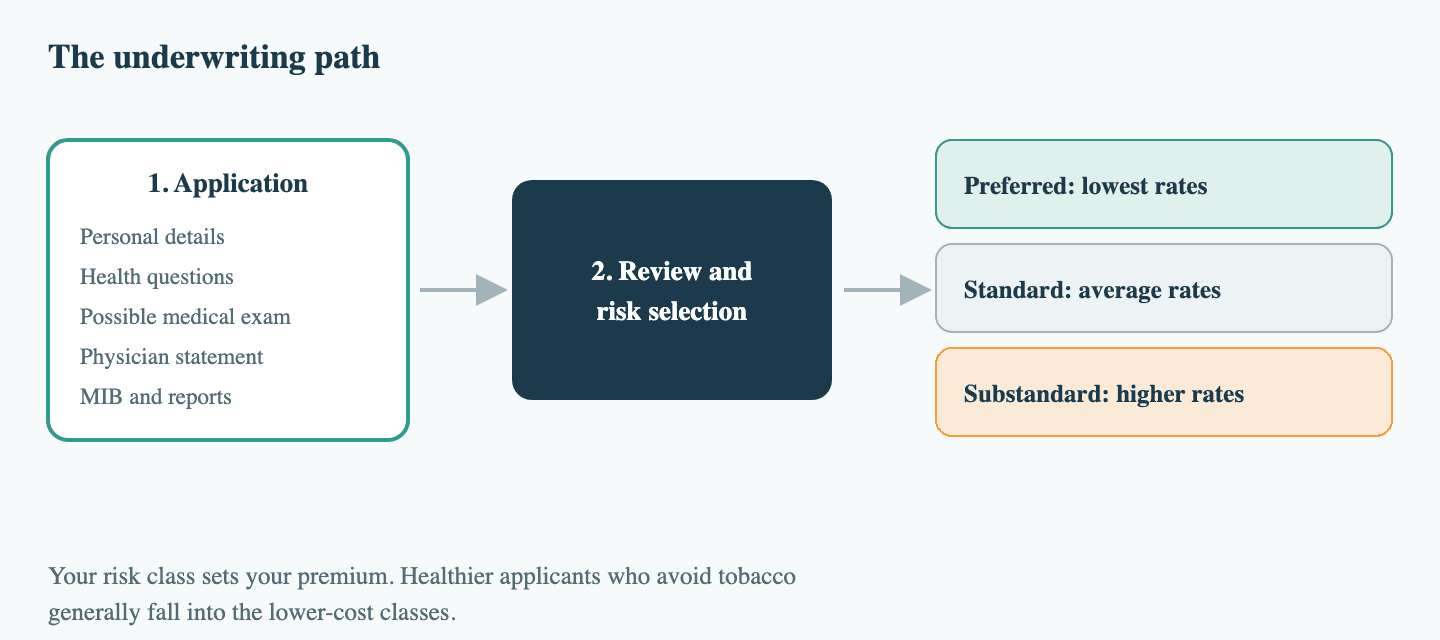
The application typically comes in two parts. The first gathers general information such as your age, address, occupation, and the other coverage you own. The second focuses on health: your medical history, current conditions and medications, your doctor's contact information, and questions about tobacco use, alcohol and drug use, high-risk hobbies, and travel.
To verify and fill in that picture, insurers may draw on additional sources, including an attending physician's statement from your doctor, a medical exam, consumer reports, prescription and motor vehicle records, and MIB (formerly the Medical Information Bureau), an industry database of prior applications.
Medical exam vs. no-exam policies
Whether an exam is required usually depends on how much coverage you are buying and the insurer's rules. Larger policies are more likely to require a paramedical exam that records your height, weight, blood pressure, and blood and urine samples. Smaller and mid-size policies are increasingly written on a simplified issue or no-exam basis, where a set of health questions replaces the lab work.
It is important to understand that no medical exam does not mean no underwriting. The insurer still evaluates your answers against third-party data, and an inaccurate response can jeopardize a future claim, particularly during the policy's contestability period.
Risk classes
Once the insurer has the information, it sorts applicants into risk classes that drive the rate:
- Preferred applicants show a below-average risk of loss and earn the lowest rates
- Standard applicants reflect average risk and pay standard rates
- Substandard applicants, who have health, occupation, or lifestyle factors that raise the risk, are typically still offered coverage, but at a higher premium
Because pricing is built largely on age and health, the healthiest time to lock in a rate is usually now rather than later.
What moves your rate
The factors that move your rate are a mix of things you cannot change and things you can. Age and sex are fixed inputs, and women generally pay less at most ages because of longer average life expectancy, though the gap narrows and can invert in particular age and coverage bands. Coverage amount and term length are choices you control, and so, to a degree, are health habits.
Progressive lists age, gender, health, tobacco use, hobbies, occupation, criminal history, financial history, and the coverage amount you select as factors that influence what you pay, noting that "the riskier your job, the more you could pay for life insurance."
Riders and living benefits
A rider is an optional add-on that expands what a policy does. A few are especially worth knowing about with term life.
Accelerated death benefit
An accelerated death benefit, sometimes marketed as living benefits, lets you draw down part of your own death benefit early if you are diagnosed with a qualifying terminal or serious illness. Access to that money can help cover medical bills or day-to-day costs when you need it most. These riders are standard on many individual policies today, and whatever you draw is subtracted from the amount your beneficiary later receives.
Waiver of premium
A waiver of premium rider keeps the policy in force without premium payments if you become totally disabled and cannot work, after a waiting period. It protects your coverage during exactly the kind of income disruption that might otherwise cause a policy to lapse.
Accidental death benefit
An accidental death benefit, sometimes called double indemnity, pays an additional amount, often equal to the face amount, if death results from a covered accident. It is inexpensive but narrow, since it only applies to accidental causes.
Conversion
The conversion feature, covered above, is one of the most valuable options on a term policy, because it lets you move to permanent coverage without a new medical exam if your needs or health change. Watch the conversion deadline, which is often much shorter than the term itself.
Riders vary by insurer and state, and each generally adds to the premium, so it is worth reviewing which ones are included by default and which cost extra.
How a term life payout is taxed
One of the quiet advantages of life insurance is its tax treatment. According to the IRS, "life insurance proceeds you receive as a beneficiary due to the death of the insured person, aren't includable in gross income and you don't have to report them." In other words, the lump sum your family receives is generally free of federal income tax.
Several nuances are worth knowing:
- If the insurer holds the money and pays it out with interest over time, the interest portion is taxable even though the death benefit is not.
- Income tax and estate tax are different questions. If you own the policy at death and your estate is large enough, the death benefit can still be counted in your taxable estate. Naming a beneficiary directly also keeps the proceeds out of probate; leaving the beneficiary blank can send them to your estate instead.
- Benefits paid early under an accelerated death benefit are excludable under Section 101(g) of the Internal Revenue Code. For a terminally ill insured, that means a physician has certified an illness reasonably expected to result in death within 24 months. For a chronically ill insured, the exclusion is subject to additional conditions and per-diem limits. These payments are reported to the IRS on Form 1099-LTC.
Tax situations vary, so confirm the details for your circumstances with a qualified professional.
Common myths about term life insurance
"It's too expensive"
For most people it is dramatically cheaper than they assume. A healthy 30-year-old can often find substantial term coverage for the price of a couple of streaming subscriptions. Guardian puts $250,000 of 10-year coverage at about $13 a month for a 30-year-old male non-smoker in a preferred health class, with women's rates lower still. Progressive lists a comparable $250,000, 10-year policy at about $15.01 a month for a 30-year-old woman and $16.10 for a 30-year-old man.
"I only need it if I'm the sole breadwinner"
A second income, childcare, and household work all have real financial value. Losing any of them can strain a family, which is why two-income households often insure both partners.
"My coverage at work is enough"
Employer group coverage is a helpful baseline, but it is usually capped at around $50,000 or one to two times your salary, and it typically ends when you leave the job. A personal term policy moves with you and can be sized to your actual needs.
"No medical exam means it isn't real coverage"
No-exam and simplified issue policies are legitimate coverage from the same insurers. They replace the lab work with health questions and third-party data rather than skipping underwriting altogether.
How Eleos fits in
Eleos was built to strip the friction out of getting covered. The experience is fully digital: you answer a few qualification questions to get a monthly quote, adjust your coverage to fit your budget, and activate the policy with your first payment. There are no lengthy forms to mail and no waiting weeks on a decision.
Two things stand out for people who have been put off by traditional applications. First, there is no medical exam, and a large share of coverage requires few or no health questions, so the conditions that complicate a standard application do not automatically stand between you and a policy. Second, a policy is more than a payout: Eleos pairs its term coverage with telemedicine and mental health support, and an assistant named Theea is available around the clock to help you understand your options and design coverage that fits.
Eleos term life is aimed squarely at the everyday families and working people this guide is written for: those who want meaningful protection without the exam, the paperwork, and the uncertainty of a long underwriting review. You can get a quote online in a few minutes and see exactly what your coverage would cost. As with any policy, review the official plan documents for the full terms, amounts, and any limitations that apply in your state before you buy.
Sources
- National Association of Insurance Commissioners, "What Type of Life Insurance Is Right for You?"
- National Association of Insurance Commissioners, Life Insurance Buyer's Guide
- Guardian, "Term Life Insurance: Types and How It Works"
- Guardian, "Term Life vs. Whole Life Insurance: Key Differences"
- Guardian, "Term Life Insurance Rates"
- Guardian, "How Much Does Whole Life Insurance Cost?"
- Progressive, "How Much Is Life Insurance: Average Costs"
- Internal Revenue Service, "Life Insurance & Disability Insurance Proceeds"
- Internal Revenue Service, Instructions for Form 1099-LTC (accelerated death benefits)
What Is Term Life Insurance? A Complete U.S. Guide
Frequently asked questions
Fact-checked and reviewed by Kiruba Shankar Eswaran or another licensed agent on our team. Read our editorial standards.
This guide is for general educational purposes and is not insurance advice. Product features, availability, and amounts vary by state and by policy. Always review the official plan documents for the full terms, limitations, and exclusions before you buy.
Related resources

Life Insurance for Self-Employed Workers
A practical US guide to life insurance for self-employed workers: why you start with zero coverage, term vs whole life, how much you need (DIME), taxes, and applying honestly with a high-risk job.

Term Life Insurance for Seniors: Over-50s, 60s and 70s Guide
A practical US guide to term life insurance for seniors in their 50s, 60s and 70s: how term length shrinks with age, the health questions that trigger declines, and why guaranteed issue is often the better fit.

Life Insurance for high-risk employees
Getting life insurance coverage can be difficult if your job is dangerous, but it's definitely still possible!

8 Celebrities Who Worked in Insurance
Think selling insurance is just for the suit and tie crowd? Think again. Here are 8 famous faces you probably didn’t know started out in the insurance industry!

How to use the DIME method to calculate your life insurance needs
DIME is a powerful, personalized approach that helps you calculate precisely how much life insurance coverage you need.