life insurance
Life Insurance for Self-Employed Workers
Fact-checked and reviewed by Kiruba Shankar Eswaran or another licensed agent on our team. Read our editorial standards.
This guide is for general educational purposes and is not insurance advice. Product features, availability, and amounts vary by state and by policy. Always review the official plan documents for the full terms, limitations, and exclusions before you buy.
According to the U.S. Bureau of Labor Statistics, roughly 16.4 million Americans are self-employed. That figure combines about 9.7 million unincorporated self-employed workers with about 6.6 million whose businesses are incorporated, based on the July 2026 Employment Situation report. Worth noting: BLS counts the incorporated self-employed as wage and salary workers in its headline numbers, which is why the two groups are reported separately.
From freelancers to founders, self-employed workers are a pillar of the American workforce.
Being self-employed comes with real advantages, from setting your own hours to working from home, but it also means you carry the weight of being your own HR department. That includes your own benefits.
Traditional employees often get access to employer-provided group life insurance, a low-cost policy that provides a basic level of coverage automatically. That coverage is usually capped at around $50,000 or one to two times annual salary, and it generally ends when the job does. When you are self-employed, you usually start with zero default coverage. If you do not buy a private policy, you have no protection in place.
That does not make life insurance any less important for a self-employed worker. Your family can be just as dependent on your income. Recent industry surveys put average full-time freelancer earnings close to six figures, so you may well be the primary breadwinner in your household. As more Americans choose entrepreneurship and gig work, buying your own personal coverage has never mattered more.
"Life insurance" is the umbrella. Underneath it sit different products, mainly term life and permanent (whole) life, and they work very differently. This guide keeps those straight so you can see which one fits your situation.
Life insurance for a self-employed worker functions much like coverage for a traditional employee, with one key difference: you have to arrange it yourself. A few things are worth keeping in mind before you apply.
If you apply for a high level of coverage, some insurers will want to verify your income during underwriting. A traditional employee might do this with a W-2 or pay stubs. As a self-employed worker, you may need your tax returns on hand instead, typically the last two years, along with a profit and loss statement. Not every policy or coverage amount requires income verification, but larger benefit amounts are more likely to.
A common myth is that life insurance premiums are tax-deductible. For most self-employed people insuring their own lives, they are not. Section 264(a)(1) of the Internal Revenue Code denies a deduction for premiums on any life insurance policy covering you, an employee, or anyone with a financial interest in your business, if you are directly or indirectly a beneficiary of that policy. The IRS repeated this language in Publication 535, Business Expenses, which was last issued for tax year 2022; small business expense guidance now lives in Publication 334 and the Schedule C instructions.
On the other side, the news is better for your family. The IRS states that life insurance proceeds received by a beneficiary because of the insured person's death are generally not includable in gross income and do not have to be reported, though any interest paid on top of the benefit is taxable and must be reported as interest received.
Most desk-based occupations get approved quickly. Physically dangerous work can add complexity and cost. Be completely honest about what you do on the application. If you are a contractor who occasionally works at height but you describe yourself only as a "consultant," an insurer may have grounds to contest or deny a claim tied to a work accident, particularly within the policy's contestability period (usually the first two years). Accuracy protects your beneficiaries.
Many term life policies include, or offer as a rider, an Accelerated Death Benefit that lets you access part of the death benefit early if you are diagnosed with a terminal illness. For a self-employed person, that early payout can help settle business debts, cover medical bills, or fund a succession plan while you are still able to oversee it.
Two things to understand: accelerated benefits paid to a terminally ill insured are generally excluded from income under Section 101(g) of the Internal Revenue Code, and any amount you accelerate reduces the death benefit your beneficiaries eventually receive. Look for an Accelerated Death Benefit or "living benefits" rider, and check whether your insurer includes it at no extra cost.
Once you choose a provider, whether through your own research or a licensed broker, you can tailor the policy to your needs and put your coverage in force.
The biggest question most self-employed workers ask is simple: what kind of life insurance do I actually need? In the U.S., you generally choose between two broad categories.
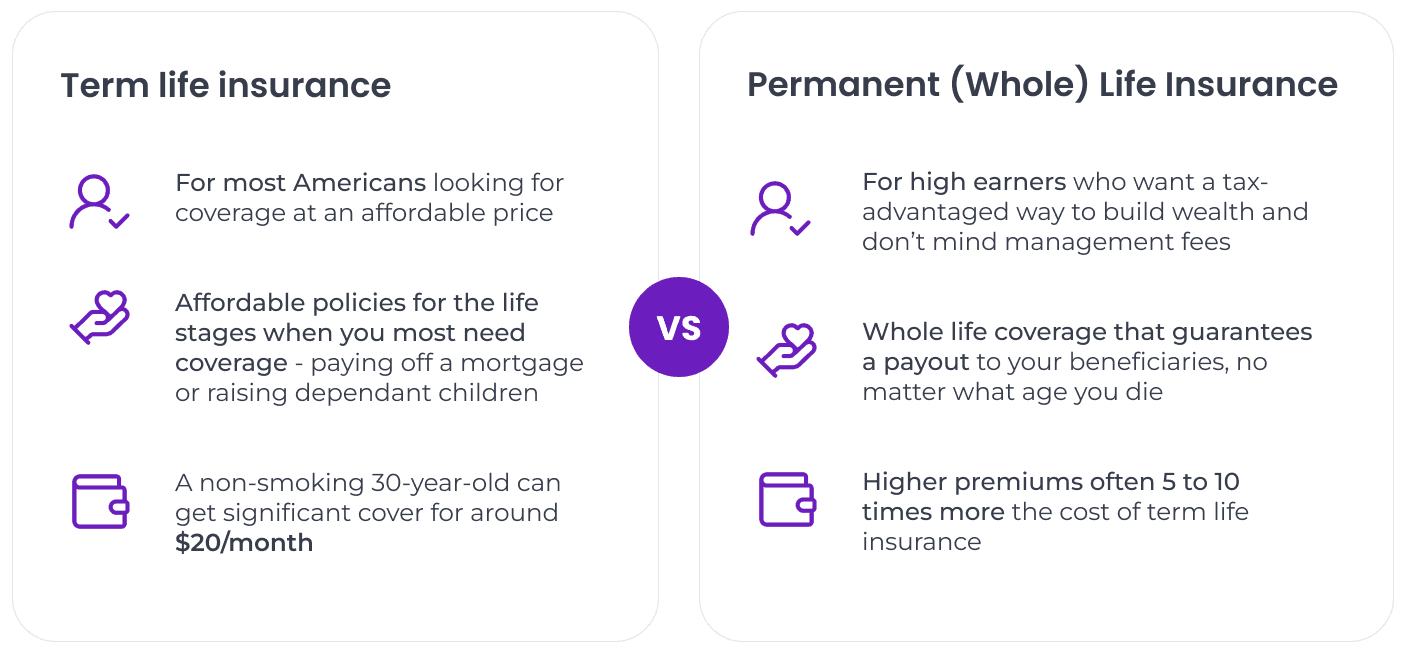
Term life is the more affordable option. It covers you for a set period, commonly 10, 15, 20, or 30 years, though some insurers offer 25- and 40-year terms. People sometimes call it "pure" life insurance because it is protection only, with no investment component. The idea is straightforward: you pay a premium, and if you pass away during the term, your beneficiaries receive the death benefit.
If your main goal is protecting your family while you carry a mortgage or raise young children, term life is usually the most efficient choice.
Most Americans, including freelancers and self-employed workers, especially anyone covering a need with a clear end date such as paying off a mortgage or supporting dependent children.
Rates depend heavily on age, health, coverage amount, and term length, but a healthy, non-smoking 30-year-old can often find a policy for a low monthly premium.
Whole life insurance combines lifelong coverage with a savings component. Part of each premium goes into an account that builds "cash value" over time, which grows tax-deferred and which you can often borrow against later. Policy loans accrue interest, reduce the death benefit if they are not repaid, and can create a taxable event if the policy lapses or is surrendered with a loan outstanding. With those caveats, the feature makes it an occasional alternative to a traditional loan.
People with a genuinely permanent need, such as final expenses, estate liquidity, or a dependent with lifelong care needs. It also appeals to higher earners who have already maxed out other retirement accounts and want another tax-deferred way to pass on wealth, provided they do not mind the added cost. Business owners sometimes use permanent coverage to fund a buy-sell agreement or key person protection, though business-owned policies carry their own tax rules, including the notice and consent requirements under Section 101(j).
Premiums are far higher than term for the same death benefit. Guardian's sample data shows a 30-year-old paying roughly $23.50 to $28 a month for $500,000 of 20-year term coverage, versus about $330 to $359 a month (roughly $3,959 to $4,311 a year) for the same $500,000 in whole life. That is roughly twelve to fourteen times the cost at that age.
Choosing between term and whole life is a personal decision that should match your specific circumstances, budget, and goals. For most self-employed workers protecting a time-limited need, term life delivers the most coverage per dollar.
Freelancers and business owners have one advantage here: they can size a policy to their own life instead of accepting a one-size-fits-all employer plan, which is often set at just one or two times salary.
A common rule of thumb for estimating your coverage is the DIME method, which reminds you to add up four things:
Numbers are only part of it. It helps to have a frank conversation with your beneficiaries about how many years of income they would need, and what other resources they could rely on if you were no longer there.
Providers that offer personal term life policies are used to working with self-employed applicants. Personal policies are designed to move with you across jobs, homes, and life stages.
Remember that a high coverage amount may require you to verify income through tax returns, so keep those documents handy if you expect to apply for a large policy.
Above all, be clear and transparent about what your work involves. Underwriters price a policy on accurate information, and making your job look less risky than it is might lower your premium today at the cost of a denied claim later.
Life insurance is not only about death. It is about the peace of mind that lets you take the risks a business requires. When you know your family and your legacy are protected, you can focus on what you do best: building something of your own.

A practical US guide to term life insurance for seniors in their 50s, 60s and 70s: how term length shrinks with age, the health questions that trigger declines, and why guaranteed issue is often the better fit.

A plain-English US guide to term life insurance: how it works, the main policy types, term vs whole life, how much you need, underwriting and no-exam options, riders, taxes, and common myths.

Getting life insurance coverage can be difficult if your job is dangerous, but it's definitely still possible!

Think selling insurance is just for the suit and tie crowd? Think again. Here are 8 famous faces you probably didn’t know started out in the insurance industry!

DIME is a powerful, personalized approach that helps you calculate precisely how much life insurance coverage you need.