18 Embedded Insurance Companies in the US (2027)

Short answer: 18 companies actively sell embedded insurance to US partners today, from device protection giants like Assurant and Asurion to specialists in travel, renters, auto and small business. Almost none of them publish what they charge partners. Only 5 of the 18 say how fast a partner can launch.
Embedded insurance is coverage sold inside another company's product, app or checkout, instead of on its own. Think of a protection plan offered when you buy a TV, or renters insurance offered when you sign a lease.
We work in this market, so we hear the same two questions all the time. Who sells embedded insurance in the US? And what does it actually cost?
The first question is easy to answer. The second is not. So we checked each company's partner pages, product pages and public announcements in November 2026. For every company, this guide covers what it sells, what it has made public about fees, how much you can change, and how fast you can launch. Where a fee isn't published, we say so instead of guessing.
We're on this list too, so read our entry with that in mind.
Three things to know first
The same name can mean different things. A company might be an insurer, a managing general agent (MGA), a licensed agency, a software platform, or all four across different programs. Always ask who the insurer of record is, state by state.
Fees are the gap. Most enterprise deals are quote only. You usually won't see a real number until a proposal arrives.
State filing is the delay. Insurance is regulated state by state, so a national launch is really a set of state launches. Ask who pays for filings, which states are live today, and who the producer of record is in each state.
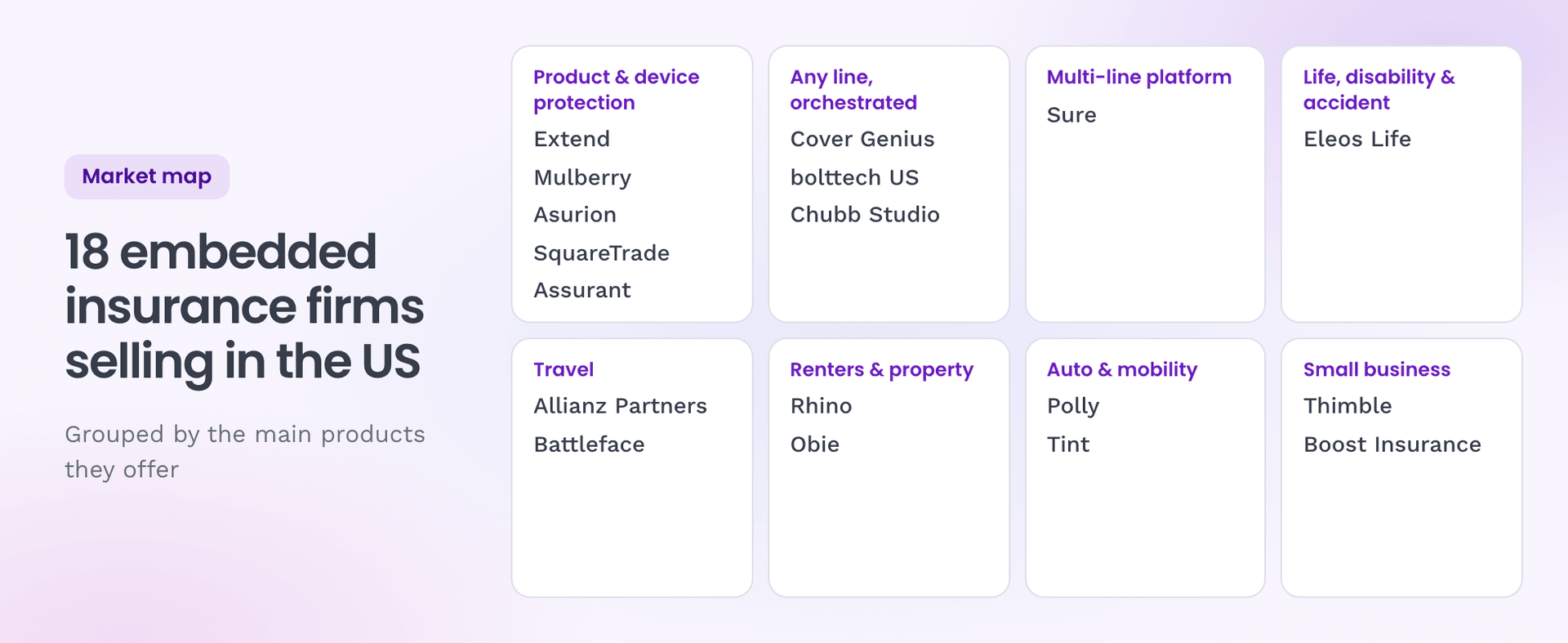
The 18 embedded insurance companies, on one page
"Fees public?" means partner fees, not what a customer pays. "Launch" means how fast a partner can go live, not how fast a customer gets coverage.
| Company | What it is | Main products | Fees public? | How much can you change? | Launch |
|---|---|---|---|---|---|
| Eleos Life | Licensed producer | Term life, disability, accident | Partly: $0 setup and platform | Set products, your brand | Within days (see profile) |
| Cover Genius | Platform and intermediary | Travel, tickets, shipping, warranties, renters | Small business only | Configured to tailored | Not published |
| bolttech US | Exchange and device protection | Property and casualty marketplace, devices | No | Mostly configured | Not published |
| Chubb Studio | Insurer | Travel, purchase, device, accident, life, cyber | No | High, for large partners | Not published |
| Sure | Software platform and producer | Renters, auto, commercial, gig, wearables | No | High | Weeks, not months |
| Extend | Platform and administrator | Product and shipping protection | Structure only | Configured | Days to 2–4 weeks |
| Mulberry | Product protection platform | Extended and accident plans | Structure only | High, set up by Mulberry | Not published |
| Assurant | Insurer and administrator | Mobile, auto, renters, home | No | Bespoke, enterprise | Not published |
| Asurion | Administrator and agent | Carrier device plans, retail plans, home tech | No | Configured per partner | Not published |
| SquareTrade | Administrator (Allstate) | Product and accident plans | No | Configured retail programs | Not published |
| Allianz Partners USA | Partner division of Allianz | Travel, ticket and registration protection | No | Configurable, filed plans | Not published |
| Battleface | Travel MGA and distributor | Modular travel, medical, assistance | No | Bespoke, benefit by benefit | Not published |
| Rhino (with Jetty) | Deposit platform and distributor | Security deposit insurance, renters | Partly: platform free | Configured | Not published |
| Obie | Licensed broker | Landlord insurance | No | Configured, one product | Not published |
| Polly | Licensed agency | Auto insurance in car buying | Partly: no-cost setup | Configured distribution | Not published |
| Tint | Platform and MGA | Mobility, logistics, short-term rental | No | Configured per vertical | Not published |
| Thimble | Digital MGA | Small business coverage by the hour, day or month | Structure only | Tiered | Widget in minutes |
| Boost Insurance | Full-stack MGA | Small business, cyber, liability | No | White label to ground-up | 3–6 weeks, white label |
What partners actually pay
Here is the whole fee picture in one view. Four companies have put real partner numbers or terms in public. Three explain how the deal works but not the percentage. The other eleven publish nothing.
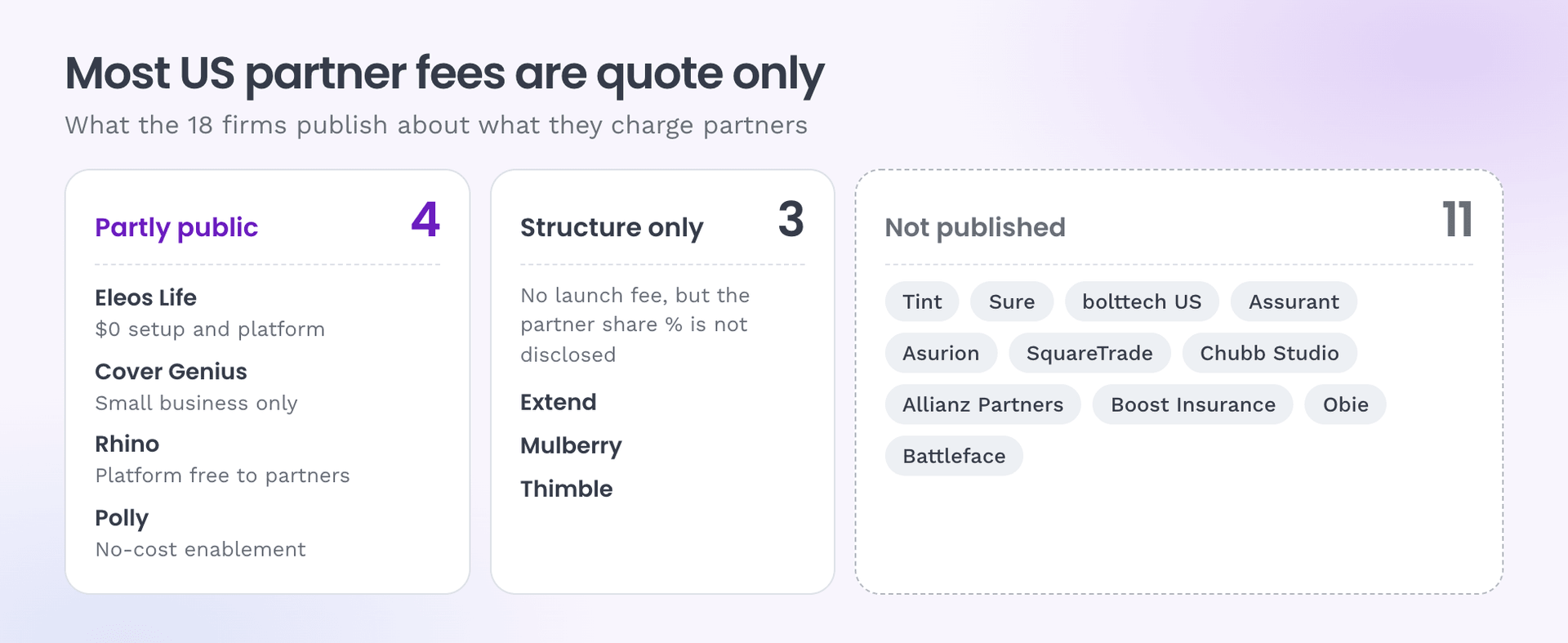
The public terms, company by company:
- Eleos Life: no setup fee and no platform fee. Partners earn a share of each policy, but the percentage isn't published.
- Cover Genius: the small business product, XCover Go, is listed as starting at $0 a month, with up to 80% commission on warranties. This doesn't apply to enterprise deals, which are quote only.
- Extend and Mulberry: no fees to launch. The merchant's share isn't published.
- Rhino: RealPage material says integration and the platform are free for property partners.
- Polly: no cost to enable its Dealer.com integration. Dealers are paid per qualified lead, and the amount isn't published.
- Thimble: its partner API launched free, with partners paid through commission. The percentage isn't published.
How fast partners can launch
Only five companies publish a launch time. For the other 13, you'll need to ask, and state filing may be the deciding factor.
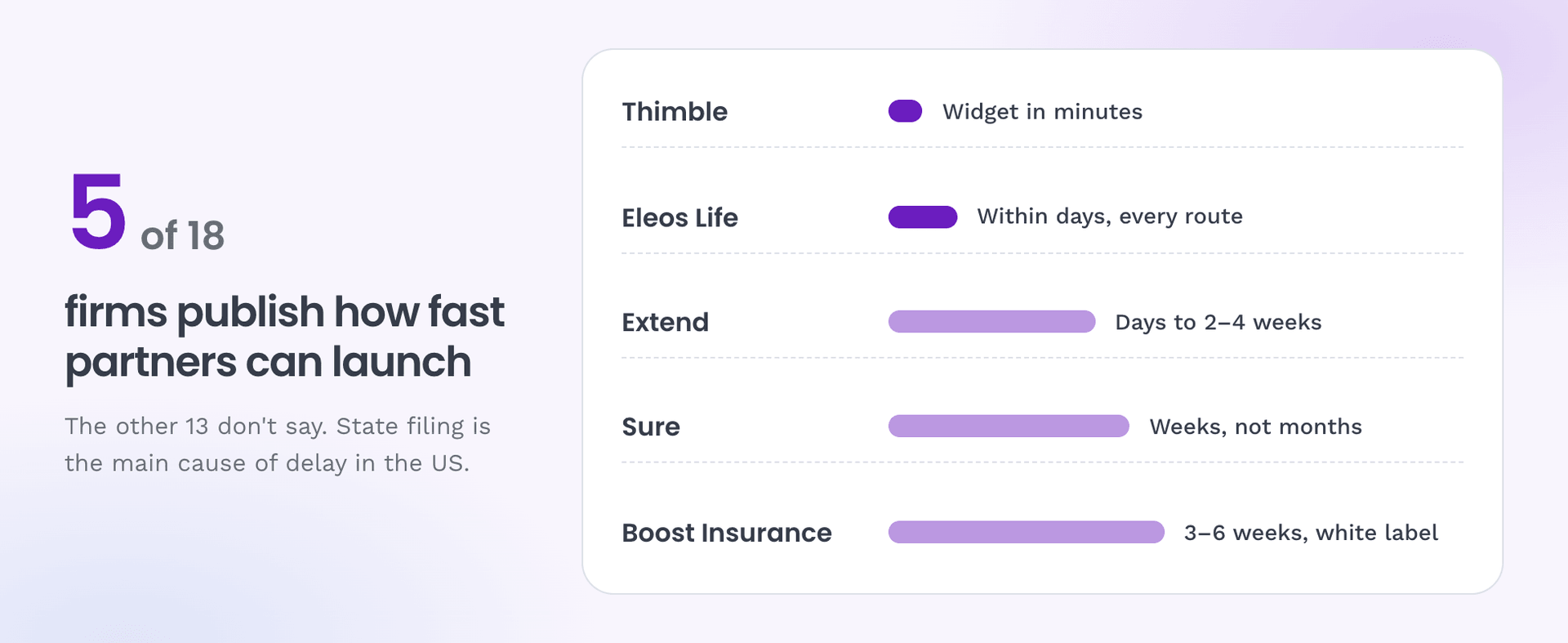
Don't confuse launch time with customer speed. A landlord quote in 3 to 5 minutes, or host coverage within a business day, tells you how fast a customer gets served. It doesn't tell you how fast your program goes live.
Life, disability and accident
Eleos Life
What it sells: term life up to $2 million, disability and accident coverage, which can be sold individually or bundled as a perk. Applications take about 15 minutes with no medical exam. We're a licensed producer, not the insurer. Policies are issued by licensed US insurers.
- Who it's for: banks, credit unions, mortgage lenders, P&C agencies, and savings and investment apps.
- Fees: no setup fee, no platform fee and nothing to staff. You earn a share of each policy. We don't publish the percentage, so ask us.
- Customization: three set products under your brand, not bespoke product design. There are three ways in: referral links, white label and a full API.
- Launch: we put it at within days for all three routes. Our partner FAQ still shows longer times for white label (a couple of weeks) and API (most partners within a quarter), so ask us to commit to a date in your contract.
- Watch out: products are available in all states except New York. Ask for a state list for each product.
Product and device protection
This is the biggest and most established part of the market. If you sell physical goods or phones, start here.
Extend
What it sells: extended protection plans of 1 to 3 years for electronics, appliances, jewelry, furniture and more, plus shipping protection. Named merchants include Peloton, Sonos and Casper.
- Fees: no cost to offer and no fees to launch. Merchants get a share of the plan price. The share isn't published.
- Customization: works through an SDK or API, with Shopify and BigCommerce integrations. Extend's branding appears wherever an offer shows, so programs are co-branded.
- Launch: days on Shopify, 2 to 4 weeks for agency and platform partners.
- Ask: what minimum sales, attach rate or exclusivity sits behind the no-fee offer?
Mulberry
What it sells: extended and accident plans across furniture, appliances, jewelry, electronics, mattresses, tires and more. Named retailers include Breville, Burrow and Lovesac.
- Fees: retailers pay no fees to launch or run a program and fund no reserves. The share isn't published.
- Customization: Mulberry says it sets terms and pricing for each retailer's catalog. Mulberry loads the pricing, so this isn't self-serve.
- Launch: not published.
- Ask: who is the backing insurer today, and what happens to live plans if that changes?
Assurant
What it sells: mobile protection, vehicle service contracts, renters insurance and more. Named programs include T-Mobile Protection 360, Verizon and AT&T.
- Fees: quote only.
- Customization: bespoke enterprise programs with partner-branded front ends. There's no public API or widget.
- Launch: not published.
- Watch out: this is enterprise, multi-year contracting. Check its appetite for a mid-size program before detailed design work.
Asurion
What it sells: carrier device protection for Verizon, AT&T and Cricket, retail plans through Amazon, Walmart and Staples, and home tech support plans. It also owns uBreakiFix.
- Fees: quote only. Asurion is private and publishes no financials.
- Customization: configured per partner and co-branded. Asurion stays visible in claims and repair. There's no public API.
- Launch: not published.
- Ask: how does the price split between your commission, Asurion's administration and the insurer's premium?
SquareTrade
What it sells: product and accident plans through major retailers, including Walmart, Costco, Target and Amazon. Allstate bought SquareTrade in 2017, and it trades as Allstate Protection Plans.
- Fees: quote only.
- Customization: configured retail programs by category, term and price band. There's no public API.
- Launch: not published.
- Watch out: plans generally don't cover loss or theft, which matters for phones. Branding varies by retailer, so confirm which name your customers will see.
Any line, through one partner
Cover Genius
What it sells: almost any line through its XCover platform, including travel, ticket refunds, shipping, warranties and renters. Named partners include Booking, SeatGeek, eBay and Uber.
- Fees: enterprise deals are quote only. Small business terms are in the fee section above, and they don't carry over to enterprise deals.
- Customization: configured to tailored, through one API. Servicing runs through XCover, so the Cover Genius brand stays visible after the sale.
- Launch: not published for enterprise.
- Watch out: its best-known partners are very large. A mid-size partner should test minimums before investing in integration.
bolttech US
What it sells: a property and casualty marketplace covering auto, home, renters, pet and more, plus device protection. It isn't an underwriter.
- Fees: quote only.
- Customization: mostly an off-the-shelf catalog. Device protection is tailored per partner.
- Launch: not published for US embedded programs.
- Watch out: several entities sit inside the US business. Pin down who contracts with you, who holds the license and who receives the fee.
Chubb Studio
What it sells: products by vertical for banks, fintechs, retailers, gig platforms and travel, including scam, device, accident and term life coverage. US offers are underwritten by ACE American and affiliates.
- Fees: quote only.
- Customization: high, at enterprise level. Microsites, SDKs and open APIs are available, and white label is the norm.
- Launch: not published for the US.
- Ask: are integration, the Studio license and AI tools charged separately?
Sure
What it sells: about 40 programs across renters, auto, commercial, gig work and wearables. Named partners include Carvana and Betterment. Insurers keep regulatory control, and Sure's agency is the licensed producer.
- Fees: platform fees aren't published.
- Customization: high, built from a library of filed products. White label can include your own domain.
- Launch: weeks, not months, by Sure's account. It cites one partner launching 3 products in under 30 days.
- Ask: is filing included, and what are the exit terms if you leave its platform?
Travel
Allianz Partners USA
What it sells: travel protection in airline, hotel, cruise and online travel journeys, plus event ticket and race registration protection. Its US entity is AGA Service Company.
- Fees: quote only.
- Customization: configurable within filed travel plans, with bespoke work for large partners. The Allianz brand stays on.
- Launch: not published. There's no public US API.
- Watch out: in the US, treat this as a travel business. Device protection is a partnership plan with bolttech, and we found no named US program.
Battleface
What it sells: modular travel coverage that partners assemble, including cancellation, medical, evacuation and baggage. It also offers Robin Assist, which handles claims and assistance without insurance. It isn't the underwriter.
- Fees: quote only. There's no consumer rate card either.
- Customization: the highest among the travel specialists. Partners can set benefits and limits by region, traveler type and channel, and white label is the core offer.
- Launch: not published, though the steps are: design approval, staging, testing and launch approval.
- Ask: which insurer backs your program, and what happens if that changes?
Renters and property
Rhino (with Jetty)
What it sells: security deposit insurance, where a renter pays a non-refundable premium instead of a cash deposit. It also sells renters insurance and lease guarantees. Rhino merged with Jetty in February 2025.
- Fees: RealPage material says integration and the platform are free for partners. Terms for large owners aren't published.
- Customization: configurable per property, with a native RealPage integration. The renter sees Rhino or Jetty branding, not yours.
- Launch: not published.
- Watch out: the policy protects the owner, not the renter, and renters must repay approved claims. A May 2026 National Consumer Law Center report argues that deposit alternatives can leave tenants paying more with fewer protections. Weigh that before you offer one.
Obie
What it sells: landlord insurance for long-term and short-term rentals, plus insurance tracking for property managers. Obie claims 75-plus proptech partners, including Roofstock and Baselane.
- Fees: quote only.
- Customization: one product fitted into each partner's flow through APIs and co-branded pages.
- Launch: not published for partners.
- Watch out: The Baldwin Group acquired Obie in January 2026. Reconfirm terms, insurers and who pays you.
Auto and mobility
Polly
What it sells: auto insurance comparison inside the car-buying journey, with a panel of 40-plus brands and licensed agent support. It's an agency, not an underwriter, and was formerly DealerPolicy.
- Fees: no cost to enable its Dealer.com integration. Dealers are paid per qualified lead, and the amount varies by state and route.
- Customization: flexible placement on dealer sites, around a fixed product. It isn't a dealer-branded agency.
- Launch: not published.
- Watch out: another company called Polly sells mortgage technology. Make sure you're contracting with Polly Insurance Agency.
Tint
What it sells: programs in three verticals: mobility (Turo), transport and logistics (uShip), and short-term rental (Guesty, OwnerRez, Escapia). It also licenses its software, Tint OS, to other MGAs.
- Fees: partner fees aren't published.
- Customization: configured per vertical and white labeled, through an API or portal.
- Launch: not published for programs.
- Watch out: Tint has moved away from a general API for any platform. Check that your vertical fits before you start.
Small business
Thimble
What it sells: small business coverage by the hour, day, week, job, month or year, including general liability, professional liability and workers' compensation. Arch Insurance acquired Thimble in 2023. Partners include Angi.
- Fees: the API launched free, with partners paid by commission or per lead. Rates aren't published.
- Customization: tiered, from a referral link to an embedded widget to a full API. Thimble stays broker of record, so this is co-branded.
- Launch: a widget can go live in minutes. Enterprise API work takes longer.
- Watch out: availability varies by state and trade. Its partner page has also listed the API as coming soon or by application, so confirm what's open today.
Boost Insurance
What it sells: business owners policies, small business cyber, management liability and professional liability, sold under your brand. It's a licensed MGA in all 50 states, not an insurer.
- Fees: quote only. The economics sit in the insurance program, not in a software license.
- Customization: white label an active product, build one from the ground up, or move an existing book onto its platform.
- Launch: 3 to 6 weeks to white label an active product.
- Ask: how is Boost paid, and what minimum premium applies per line and per state?
Two names that are no longer on the list
You may still see these two on older lists. Neither can be contracted today by a brand that simply wants to offer coverage.
Swiss Re iptiQ Americas. iptiQ was a white label life insurer for partners. Swiss Re announced its withdrawal in May 2024 and has been selling the business in parts. In February 2026, it reported an agreement to sell iptiQ Americas, subject to regulatory approval.
Bestow. Bestow sold its insurer to Sammons Financial in 2024. It now sells software and administration to life insurers only. A brand can't buy coverage from Bestow today.
Both exits narrowed the choice for brands that want embedded life insurance. Case studies like Nubank and Revolut show why it's still worth a look.
The questions to ask all of them
Use this list on every first call. Get the answers in writing, by product and by state.
- Setup: is there a setup, integration, platform or license fee? Does a $0 offer survive a custom build, low volume or an early exit?
- Pay: how do you make money on my program, and what's the percentage or amount by line?
- Commission: is it based on gross premium or net of cancellations? When is it paid, and does it continue on renewal?
- Clawback: what do you take back after a cancellation in months 1 to 12, and in months 13 to 24?
- Pricing: who sets the customer price, and who can change it?
- Minimums: is there a minimum premium, volume, attach rate or term? What happens if we miss it?
- Claims: is claims handling included? Who pays for repairs, replacements and logistics?
- Payments: who collects premium, and who bears chargebacks and refunds?
- States: in which states is this exact product live today? Who is the producer of record in each one?
- Filing: who pays for state filings and filing changes? Who pays surplus lines taxes and fees?
- Ownership: who owns the customer, the renewal and the data if we leave?
- Exit: what are the exclusivity, term and termination rights? Which fees or commissions survive termination?
- Insurer: is the insurer behind the program fixed? Can I bring my own, and does the fee change if I do?
Our rule of thumb: if a company won't put its fee structure, minimums and state list in writing before you sign, treat its launch time and revenue share as unproven.
Where we'd start
Pick the type of company before you pick the name.
- Selling physical products? Look at Extend or Mulberry first, or Assurant, Asurion and SquareTrade if you're a large retailer or carrier.
- Need many lines in one place? Look at Cover Genius, Sure or Chubb Studio.
- Selling travel? Look at Battleface or Allianz Partners.
- In property or auto? Look at Rhino, Obie, Polly or Tint.
- Serving small businesses? Look at Thimble or Boost.
- Want to offer life, disability or accident coverage? That's us. Request a demo and we'll show you a white label flow with your logo on it.
Frequently asked questions
What is embedded insurance?
It's coverage offered inside another company's product, app or checkout. The customer buys it at a natural moment, like buying a laptop or signing a lease, instead of shopping for it separately.
How do companies make money from embedded insurance?
Usually through commission or a share of each policy or plan sold. Other deals use referral fees, per-lead fees or profit share. Most companies don't publish their rates.
Do you need an insurance license to offer embedded insurance?
It depends on the model and on what you do in the sale. In many programs, the provider handles licensing, but rules vary by state. Ask who the producer of record is, and check with your own counsel.
How long does it take to launch?
Published times run from minutes for a simple widget to several weeks for a white label program. Most companies don't publish a time at all. State filing is usually the biggest cause of delay.
What's the difference between embedded and white label insurance?
Embedded describes where the coverage is sold: inside your product. White label insurance describes whose name is on it: yours. A program can be both, or just one.
Company facts come from each company's own public material, partner listings and trade press, checked in November 2026. Where nothing is published, we've said so. Terms, products and state availability change, so confirm everything in writing before you contract. This guide is general information, not legal or financial advice. Eleos Life Insurance Services Incorporated is a licensed insurance producer. Eleos products are available in all states except New York.
Fact-checked and reviewed by Kiruba Shankar Eswaran or another licensed agent on our team. Read our editorial standards.
This guide is for general educational purposes and is not insurance advice. Product features, availability, and amounts vary by state and by policy. Always review the official plan documents for the full terms, limitations, and exclusions before you buy.
Related resources
The 50 Largest Group Benefits Insurers in the US
We read every 2024 US employer benefit filing and ranked the 50 largest employee benefits insurers by premium. Kaiser leads with $36.3bn. Split by benefit, MetLife leads dental, life and both disabilities while Blue Cross leads health and EyeMed vision.
The 100 Largest Employee Benefits Brokers in the US
We read every 2024 US employer benefit filing and ranked the 100 largest employee benefits brokers by the premium they place. Mercer leads with $10.0bn, ahead of Marsh McLennan and Lockton. Includes commission, the rate each firm charges, employers served and people covered.
What Benefits Do Big Employers Offer in the US?
We analysed 1,010,279 public Form 5500 filings, covering more than 80 million people in US employer benefit plans. Dental shows up in 95.6% of benefit packages. Both short-term and long-term disability show up in 66.3%. Here is where the missing cover sits, by industry, by state and by plan size.
How Revolut Built a Global Financial Empire
Fintech giants like Revolut aren’t just facilitating transactions; they’re fundamentally reshaping how we interact with money.
How One Change Helped Nubank Generate $150M in Passive Revenue
To be competitive in today’s neobanking landscape, Nubank knew they needed to go beyond the basics. They needed a way to deepen customer relationships while generating passive income: and embedded insurance was the key.