Life insurance after a DUI: how long insurers look back


Short answer: you can usually get life insurance after a DUI, but timing matters more than anything else. Most insurers care about how long ago it happened, whether there is more than one, and what happened to your license. The first year or two is the hardest. After about five years, most fully underwritten insurers treat a single DUI as a non-issue, though the exact cutoffs differ from company to company.
Life insurance after a DUI is usually possible. A DUI is not a medical condition, but insurers underwrite it much like one. The difference is what they measure. With a health condition, they look at severity and control. With a DUI, they mostly look at the calendar. The circumstances of the night and your explanation count for little. The date, the number of offenses, your license status and your age at the time count for a lot.
That makes DUI underwriting fairly predictable once you know how it works. The catch is that there is no single rule. Insurers set their look-back periods differently, so the same offense can be a minor surcharge at one company and a decline at another. This guide explains the common patterns, the extra charge DUIs often carry, and how to time your application. If you're new to this type of coverage, start with what term life insurance is.
How does a DUI affect life insurance cost?
Many health conditions are priced with a table rating, a percentage added to the standard price. A DUI is often priced differently. The insurer adds a flat extra: a fixed dollar amount for every $1,000 of coverage, charged each year for a set number of years.
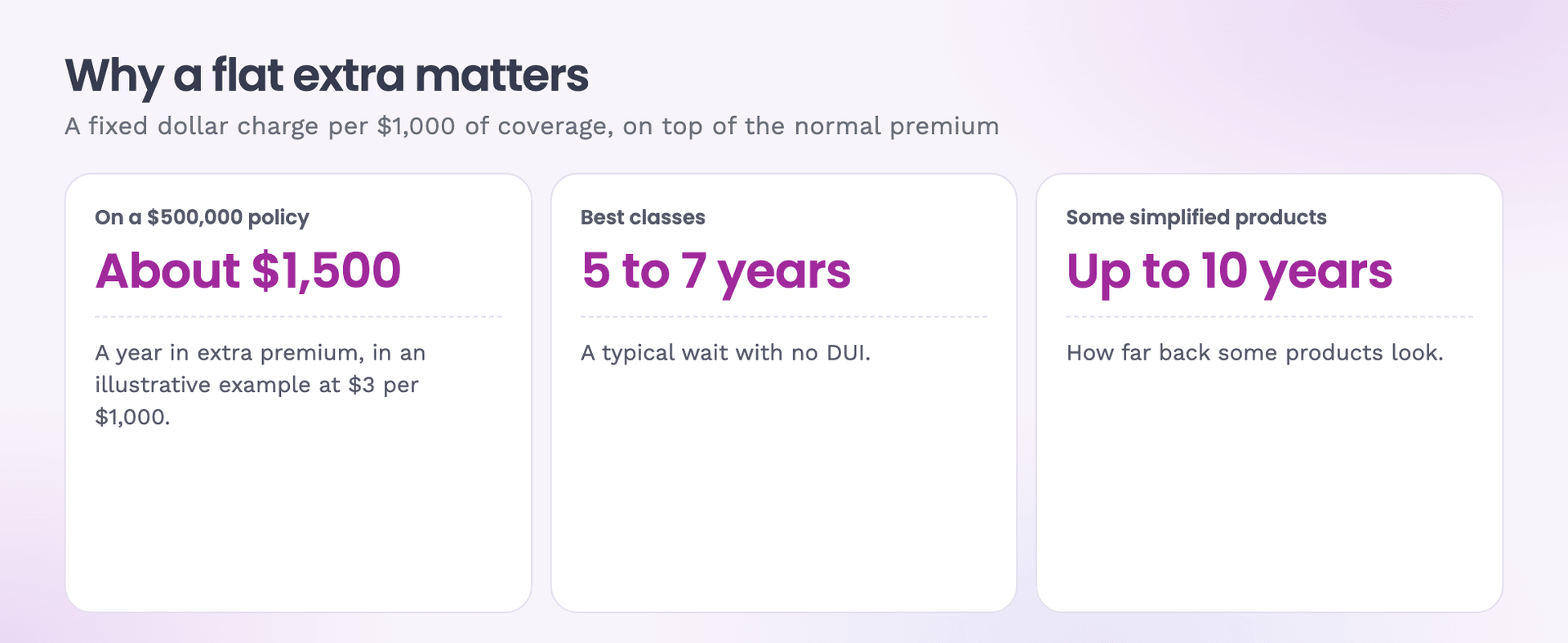
In the guides we reviewed, flat extras for a recent DUI run in the low single-digit dollars per $1,000. Here is an example, not a quote. Say a flat extra is $3 per $1,000:
- A $500,000 policy has 500 units of $1,000.
- 500 times $3 is $1,500 a year in extra premium.
- That comes on top of the normal premium, for as long as the flat extra applies.
A quote can look cheap on the first page and cost more once the flat extra is added. When you compare quotes, ask each insurer two questions: how much is the flat extra per $1,000, and for how many years does it last? A lower base price with a large flat extra can cost more than a higher base price with none.
How hard is it to get life insurance after a DUI?
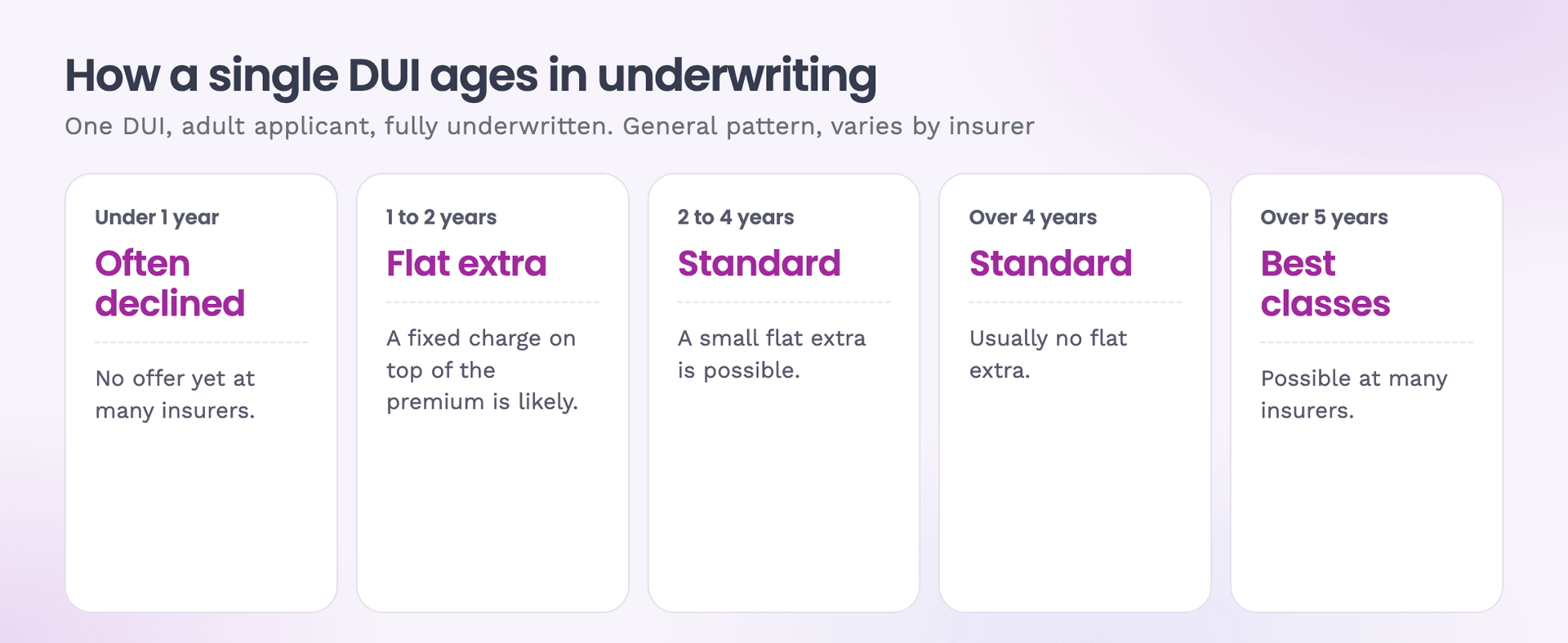
The pattern across the guides we reviewed looks like this for a single DUI and an adult applicant:
- Under 1 year: most insurers decline. No price is offered yet.
- About 1 to 2 years: coverage is often available, usually with a flat extra.
- About 2 to 4 years: standard pricing is common, sometimes with a smaller flat extra.
- After about 4 years: standard pricing without a flat extra is typical.
- After about 5 years: the best price classes come back into play at many insurers.
Two points stand out. First, the cost is front-loaded. Applying at month 13 can cost far more than applying at month 25. Second, a single old DUI doesn't close the door for good. Time does most of the work.
How far back do life insurance companies check for a DUI?
Insurers don't agree on where those lines fall. Here is how the guides differ.
- For the best classes, a five-year clean record is the most common requirement. Several insurers ask for no DUI, DWI or reckless driving conviction in the past five years. One goes further and asks for seven years without a DUI for its very top class.
- For the middle classes, some insurers ask for only two or three years. A DUI two or three years back can still qualify for a standard class at these companies, while others would still charge a flat extra.
- For more recent offenses, some insurers send the application to additional underwriting if there was a DUI or reckless driving charge in the last two years. They may ask for the offense date, the number of offenses, whether your license is currently suspended and your employment.
- For simplified products, the windows can be longer. Some decline a DUI or license suspension within the last two to three years. At least one whole life product with simplified underwriting looks back a full ten years.
So the "easy" product is not always the forgiving one. A simplified policy can have a longer look-back than a fully underwritten policy, which is one reason it pays to compare both types.
What else matters besides the date?
A second DUI changes the picture. One DUI looks like an incident. Two looks like a pattern. In the guides we reviewed, multiple DUIs are excluded from the best classes, and at least one insurer declines multiple DUIs within a four-year window. A second offense doesn't just restart the clock. It usually means a longer wait.
License suspension counts too. Several guides treat a license suspension or revocation as a separate item, inside the same look-back period as the DUI. A currently suspended license is a serious obstacle at most insurers. Gather your reinstatement paperwork before you apply.
Reckless driving is grouped with DUI. Most rules are written as "DUI, DWI or reckless driving." If your DUI charge was reduced to reckless driving, assume the insurer will still look at it. Don't assume a plea agreement keeps it out of underwriting.
Your age at the offense can matter. Some insurers apply stricter rules to offenses committed before age 21, such as a longer wait measured from the date of the violation. If your offense is old but you were young, ask which rule applies. If you're early in your adult life, our guide to life insurance for young adults may help.
Alcohol treatment is read as health history. A DUI by itself is the simplest version of this issue. If your records also show alcohol treatment or other alcohol-related findings, the application stops being only a driving case and is judged under the health rules for that history. Many guides ask for the dates of treatment and your last use. If you're also managing mental health conditions, see our guide to life insurance with depression and anxiety.
The waiting-period idea may sound familiar. Tobacco works somewhat the same way, with price classes that improve as time passes. See how long until non-smoker rates apply.
What type of life insurance is best after a DUI?
Fully underwritten policies use a medical exam or your medical records, plus your motor vehicle record. This is where the DUI look-back periods and best classes apply. If your DUI is several years old, this route often gives the best price.
Simplified-issue and no-exam policies rely on health questions, prescription records and medical information databases instead of an exam. They can still ask about your driving record or license, and some do. Others don't treat a DUI by itself as a health issue, because it isn't a diagnosis. This differs from product to product, so the application questions are what count. Some guaranteed-issue policies ask no health questions at all, though their coverage amounts are small.
Here is a practical way to think about the choice:
- Under about a year since the offense: the fully underwritten market is mostly closed. A no-exam or guaranteed-issue option, or a conversation with an adviser, may be the only way to get coverage now. You can often look at replacing it later. Keep the old policy in force until a new one is approved.
- One to two years out: you are in flat extra territory. Get the flat extra in writing from more than one insurer, per $1,000 and in years.
- Close to a boundary: if your offense will cross into a cheaper window in a few weeks and you have no urgent need, waiting may save real money over the life of the policy. Insurers generally judge the date of your application. If you need protection now, don't wait. Coverage in place is worth more than a better price on a policy you don't have.
- More than one DUI: expect declines from some insurers. Compare several and let time work for you.
Eleos offers no-exam term life insurance with an online application. It may work for an older single DUI. If the DUI is recent or you have more than one, talking to a licensed adviser first is usually the better start.
Will the insurer see my DUI?
Insurers check motor vehicle records. The offense, any plea, a suspension and a reinstatement are all documented, and the underwriter may see them while reading your application. A DUI that is disclosed accurately is a pricing matter. A DUI that was left off and later discovered can cause a decline, and a misstatement can also give an insurer grounds to contest a policy. Most states have a contestable period of about two years after a policy is issued, though the length varies by state. Answer every question accurately and completely.
Questions people ask
How long after a DUI should I wait to apply? There's no single answer. In the guides we reviewed, the first year is the hardest, standard pricing often returns between two and four years, and the best classes between five and seven. If you will cross into a cheaper window within weeks and don't need coverage right away, waiting may lower your price. If you need protection now, apply and look at replacing the policy later.
What does a flat extra cost? It varies by insurer and by how recent the offense is. It's quoted as a fixed dollar amount per $1,000 of coverage per year. As an illustration, $3 per $1,000 on a $500,000 policy adds $1,500 a year. Always ask for the per-$1,000 figure and the number of years.
What if I've had more than one DUI? Multiple DUIs are excluded from the best classes in the guides we reviewed, and at least one insurer declines multiple DUIs within a four-year window. Compare several insurers and let time work for you.
Does my license need to be valid to apply? A currently suspended license is a serious obstacle at most insurers, and some applications ask directly whether your license is suspended. Recent suspensions or revocations also count inside the look-back period. Gather your reinstatement paperwork first.
My DUI was reduced to reckless driving. Am I clear? Not necessarily. Most guides group DUI, DWI and reckless driving together. Expect the insurer to consider it.
Does a DUI affect disability insurance the same way? Many disability insurance applications also ask about driving history, and recent or multiple offenses can affect eligibility and price. The look-back periods differ by product, so don't assume a life insurance answer applies.
I have two DUIs, the last one six years ago. Is there hope? Often yes, but compare carefully. Some insurers exclude multiple DUIs from their best classes yet still offer standard pricing at that distance. Time keeps helping. Because insurers differ, a licensed adviser can save you time.
How much coverage should I get? That depends on your debts, income and family. Our guide to how much term life insurance you need explains how to work it out.
Can Eleos Life help if you have a DUI?
Yes. Eleos Life helps people with a DUI on their record find life insurance in every US state except New York. We're a licensed insurance producer working with multiple A-rated insurers, so you aren't limited to one insurer's rules. That matters because insurers judge a DUI differently, and one no isn't the last word.
We can help in two ways:
- Fully underwritten coverage: an insurer reviews your full history. This route offers the highest coverage amounts and the best chance of a fair price. Get a quote below, or talk to a licensed adviser at +1 888 998 1020.
- Guaranteed-issue coverage: no medical exam and no health questions, if underwritten coverage isn't available. Coverage amounts are lower, a waiting period applies, and availability varies by state.
We can't promise an offer from any one insurer, but we can show you which routes are open to you.
The bottom line
A DUI is one of the most date-sensitive items in underwriting. The impact usually eases in steps, at different points for different insurers, and some simplified products look back much further than others. Know your offense date, ask for any flat extra in dollars per $1,000 and in years, and compare more than one insurer. A single DUI is usually a surcharge with an end date.
Check your options with an online quote, or talk to an adviser if your DUI is recent. Quotes take minutes and carry no obligation.
This guide describes how life insurance underwriting generally works, based on the underwriting rules of the insurers Eleos works with. It isn't legal advice, insurance advice or a quote. Individual outcomes depend on your full application. Figures are indicative and current as of November 2026. For questions about your case, charges or license, talk to your attorney.
Fact-checked and reviewed by Kiruba Shankar Eswaran or another licensed agent on our team. Read our editorial standards.
This guide is for general educational purposes and is not insurance advice. Product features, availability, and amounts vary by state and by policy. Always review the official plan documents for the full terms, limitations, and exclusions before you buy.
Related resources

Life insurance with sleep apnea: how CPAP use affects your rate
Sleep apnea rarely blocks life insurance. This guide explains how severity and treatment records shape your rate and which application route to consider.

Life insurance with depression and anxiety: how insurers judge severity
How US life insurers sort depression and anxiety into mild, moderate and severe, what moves your price, and how fully underwritten and no-exam routes differ.

Life insurance with asthma: what insurers look at
How US life insurers judge asthma by severity, attacks, treatment and tobacco use, why a COPD label matters, and whether to apply fully underwritten or no-exam.

Life insurance with high cholesterol: the full picture
How high cholesterol and statins affect life insurance: what insurers measure, where their limits sit, and how to get a better price.

Life insurance after cancer: waiting periods and options
Cancer history doesn't automatically rule out life insurance. Insurers look at type and stage, time since treatment, and recurrence or spread, and their waiting periods vary widely.