Life insurance with high cholesterol: the full picture


Short answer: high cholesterol on its own usually doesn't stop you from getting life insurance. Your price depends on your total cholesterol, your cholesterol-to-HDL ratio, your treatment and the rest of your health. Limits differ from insurer to insurer, so the same blood test can get different answers.
About 1 in 9 US adults has high total cholesterol, meaning 240 or higher, according to the CDC. Many of them picture a declined application or a doubled price. What actually happens, for most people, is far less dramatic.
That said, "you will probably be fine" is not the whole story. Cholesterol can move your price, sometimes by a lot, and the difference between a fair price and a bad one usually comes down to details most applicants never hear about. This guide walks through them: what insurers measure, where their cutoffs sit, why the same blood test gets different answers at different companies, and what you can do before you apply. If you're new to this type of coverage, start with what term life insurance is.
First, what is on your blood test
A standard cholesterol panel gives four numbers:
- Total cholesterol: everything added together. Under 200 is the number doctors generally aim for.
- LDL: the "bad" cholesterol that builds up in arteries. Lower is better.
- HDL: the "good" cholesterol that helps clear the bad kind out. Higher is better.
- Triglycerides: another blood fat, often high alongside cholesterol problems.
Here is the part most people miss. Life insurers do not weight these equally. The underwriting guides we reviewed set their limits on two figures: your total cholesterol and your cholesterol-to-HDL ratio, which is your total divided by your HDL. They do not publish separate limits for LDL or triglycerides.
Why the ratio? Because it captures the balance. Take two people with a total cholesterol of 240:
- Person A has HDL of 60. Ratio: 4.0. That is a strong result.
- Person B has HDL of 35. Ratio: 6.9. That is a weak one.
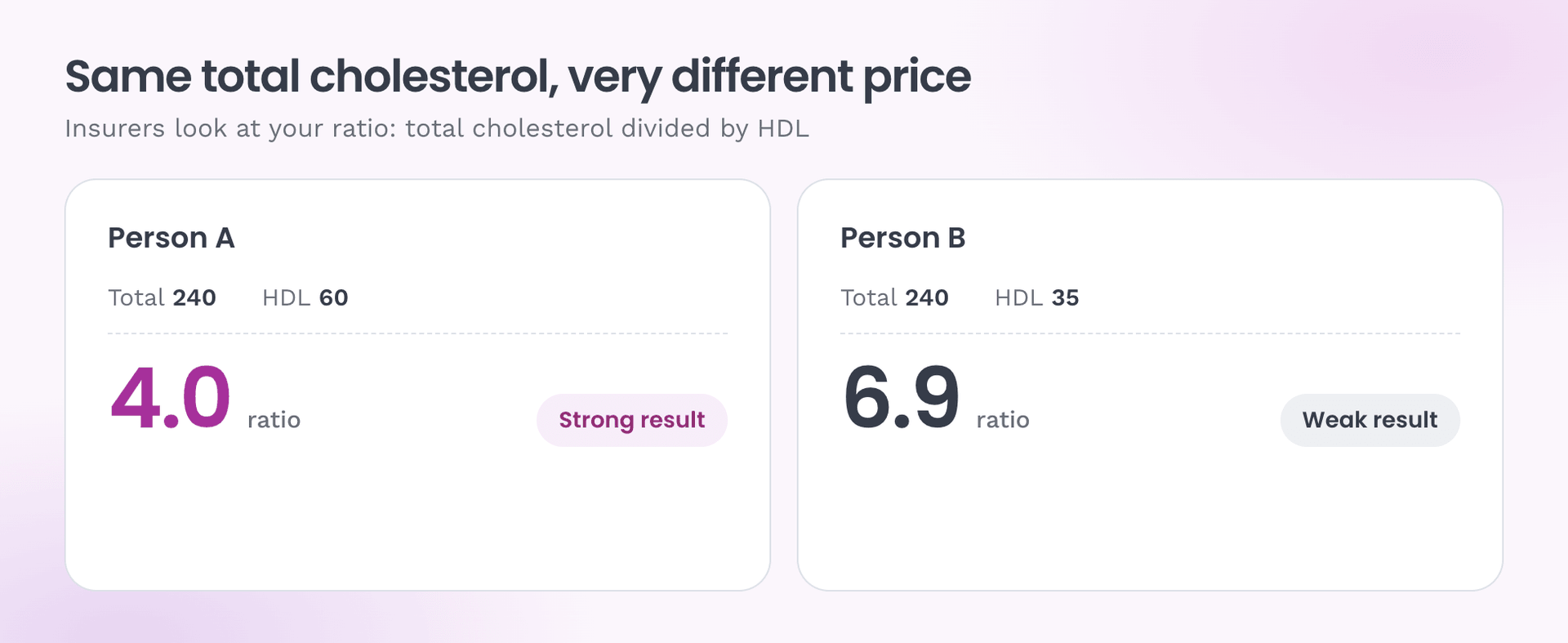
Same headline number, very different risk, and insurers can price them very differently. If you only know your total, you only know half your story. Ask for the full panel.
Where the cutoffs actually sit
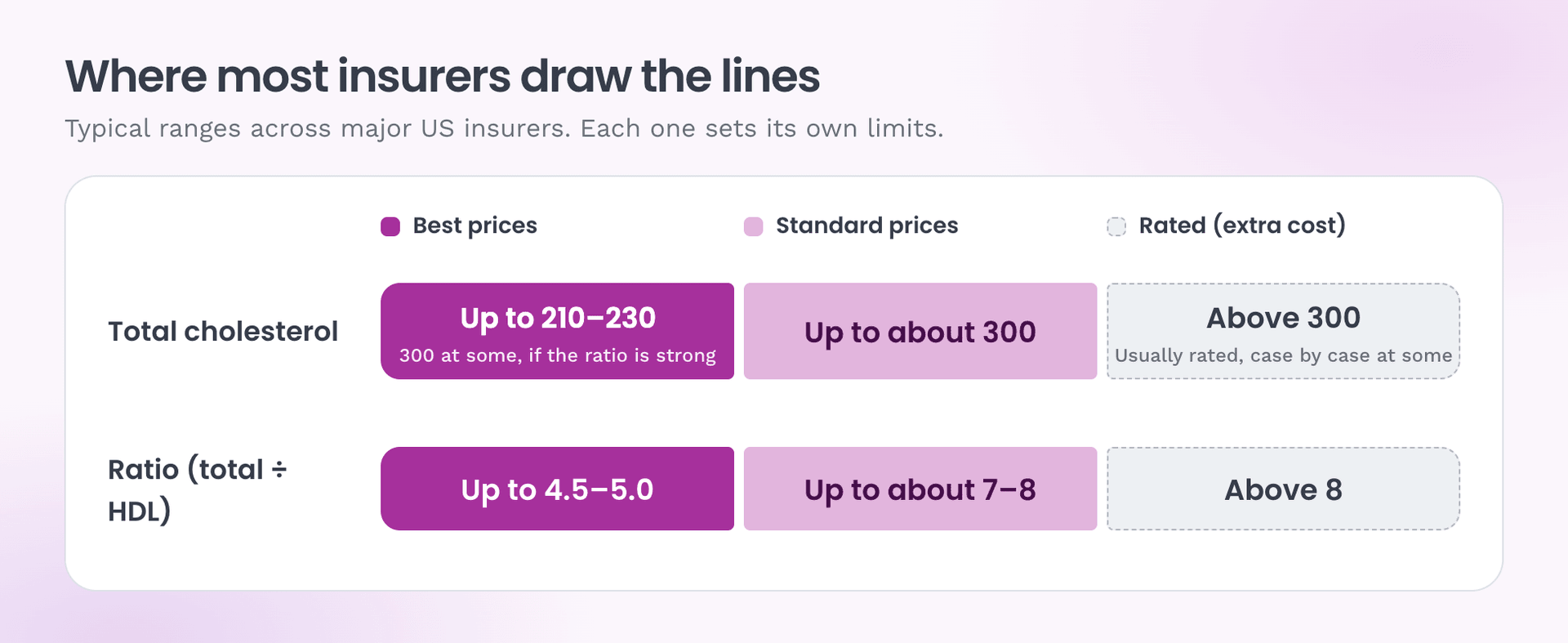
Each insurer sets its own limits in its underwriting guide. Reading across four guides that publish cholesterol limits, a pattern emerges.
For the very best prices, the ratio limit is tight: 4.5 to 5.0 at all four. The total varies more. One strict insurer caps its top class at 210, and only if you are untreated. Another stops at 230. The other two accept totals up to 300, so for them the ratio does the real work.
One class down, the limits loosen. That strict insurer accepts treated or untreated cholesterol up to 250 at its second-best class, with a ratio up to 5.0. The others allow ratios of 5.5 to just under 6.0 at that level.
For good, standard prices, the doors open much wider. Totals up to 300 are accepted by several insurers. One well-known insurer accepts 120 to 300 for every one of its price classes, treated or not, and lets the ratio run to 8.0 at Standard. Another stops at 7.0.
Past roughly 300 total or a ratio above 8, you are outside these published limits. Expect a rating at most fully underwritten insurers, meaning a standard price plus a percentage surcharge, an individual review, or a move to a different type of policy.
Three more wrinkles worth knowing:
- Age can change the math. One insurer allows a ratio 0.5 higher from age 71. At its best class, that means 5.5 instead of 5.0, so a ratio that misses a class at 45 may fit it at 72.
- Lower is not always simpler. One insurer's accepted range starts at 120, not zero. This won't affect most people, but it shows how carefully these guides are written.
- More than one reading can count. One insurer uses the average of three readings over the past 12 months, if they are available. A single good or bad result may not tell the whole story.
The statin question
One of the most expensive myths in this area: "being on medication makes me look worse."
The underwriting guides do not support that. One insurer states in writing that treatment for cholesterol does not exclude an applicant from its Preferred Plus, Preferred or Standard Plus classes. Two others set their limits "with or without treatment," meaning the number is judged the same whether a statin produced it or not. The exception in our research is the strict insurer above, which limits its top class to untreated applicants but allows treatment at the next class down.
Think about it from the insurer's side. They are not insuring your cholesterol reading on one Tuesday. They are betting on your health over 10, 20 or 30 years. A person whose cholesterol was high, who saw a doctor, took the prescription and brought it down is showing the kind of behavior that makes that bet safer.
Practical takeaways:
- Never stop or change a statin to "look better" for an application. Medication decisions belong with your doctor.
- You don't need to come off medication before you apply.
- If you were prescribed medication and stopped taking it on your own, talk to your doctor before you apply. Be honest about it on your application, because insurers can check prescription records.
How cholesterol pricing really works: classes and tables
Insurers sort applicants into price classes, best to worst, with names like Preferred Plus, Preferred, Standard Plus and Standard. Your cholesterol numbers, along with everything else, decide your class.
Fall short of Standard and you get a table rating. This sounds obscure, but it is simple arithmetic: each table step adds roughly 25 percent to the standard price. Table 2 means about 50 percent more. Table 4 means about double.
A quick illustration, not a quote. Say standard pricing for a policy is $50 a month:
- Best class might be $38 a month
- Standard is $50
- Table 2 is about $75
- Table 4 is about $100

Cholesterol alone is unlikely to land you on a high table. Where people get hurt is cholesterol plus two or three other things, each nudging the rating up. Which brings us to the real story.
Cholesterol is priced as part of a pattern
Underwriters do not simply score conditions one at a time and add up penalties. They look for patterns, and cholesterol sits inside the heart risk pattern. It matters far more when it appears alongside:
- Smoking. Tobacco has its own rate classes, and it is often the most expensive factor on an application. If you've stopped, see when non-smoker rates may apply.
- High blood pressure. Cholesterol plus blood pressure is the classic one-two punch insurers watch for.
- Diabetes or prediabetes. Cholesterol, blood pressure and blood sugar together are close to a definition of metabolic risk.
- Family history. A parent or sibling with heart disease before age 60 can make your reading look more serious than the same reading in someone with no family history.
- Build. Significant extra weight on top of high cholesterol compounds the concern.
The good news runs in the same direction. Several insurers run credit programs. Depending on the insurer, strong results elsewhere, such as a clean family history, good build, good blood pressure and no tobacco, can move you up a class or remove table ratings. One program looks specifically at applicants who miss a preferred class on just one factor, such as cholesterol. Credits vary by insurer and are never guaranteed, but one adverse finding, well offset, is a very different case from one adverse finding among five.

Fully underwritten vs. no-exam: two different games
Fully underwritten policies involve a medical exam or your medical records, blood work included. This is where cholesterol cutoffs, ratios and credits live. If your numbers are good and controlled, this route often produces the best price, because you get full credit for them.
Simplified issue and no-exam policies ask health questions instead of taking blood. High cholesterol is not a knockout question in the no-exam guides we reviewed. Their question lists cover things like heart attacks, strokes, diabetes complications and cancer. None of them asks "is your cholesterol high," and statins do not appear on the prescription exclusion lists we reviewed. These products can still check prescription and medical information records, and other conditions can still lead to a decline, so answer every question honestly.
That points to a simple approach:
- Numbers in good shape and controlled for a year or more? Get fully underwritten quotes and let the good numbers earn their discount.
- Numbers currently high, recently diagnosed, or not yet controlled? A no-exam policy can get you covered sooner, and you can look at replacing it once your readings have a track record. If you do, keep your existing policy in force until the new one is approved, and remember that a new policy is priced at your older age.
Eleos offers no-exam term life insurance, with no medical exam for most applicants and an online application that takes about 15 minutes. For someone whose cholesterol is a work in progress, that is often a sensible order of operations: protection first, optimization later.
Why quotes for the same person vary so much
Line the guides up side by side and the cutoffs are all over the place. Best-class total cholesterol: 210 at one insurer, 230 at another and 300 at two more. Ratio limits for Standard Plus: 6.2 to 7.0. For Standard: 7.0 to 8.0.
That spread is the opportunity. A total of 255 with a ratio of 5.2 misses the second-best class at one insurer and fits it at three others. Nothing about you changed. Only the rulebook did.
It also means a rated offer is not a verdict. It is one company's reading of its own guide. If you are quoted a table rating and cholesterol is the stated reason, getting two or three more quotes is not shopping around for its own sake. It is one of the most useful things you can do.
Before you apply: a short checklist
- Get a current full panel. Total, LDL, HDL and triglycerides, within the last year. Know your ratio before an insurer tells you what it means.
- Build six to twelve months of stability. One good reading helps. A pattern of controlled readings, on consistent medication, is stronger.
- Bring the supporting cast. Normal blood pressure, no tobacco, a reasonable build and no early family heart history can earn credits that offset cholesterol at some insurers.
- Be ready to explain changes. Recently diagnosed, recently started a statin, dose changed last month: these are all easier with a short, clear explanation and a follow-up reading showing the trend.
- Ask what is driving the price. If a quote disappoints, ask whether it was the total, the ratio, or cholesterol in combination. Each has a different fix, and a different insurer may treat it differently.
- Don't let a rating sit unchallenged for years. If you get covered at a rated price and your numbers then improve and stay improved, ask about reconsideration or compare new quotes.
Questions people ask
Can I get life insurance at all with high cholesterol? Usually, yes. In the guides we reviewed, totals up to about 300 can still fit a standard price class. Above that, expect a rating or an individual review. The no-exam guides we reviewed do not ask about cholesterol, though your full application still decides the outcome.
Does my cholesterol medication raise my premium? Usually not by itself. Three of the four guides we reviewed allow treatment at their best classes, and one limits its top class to untreated applicants. Control matters more than the prescription.
How high is too high? Totals up to about 300 and ratios up to about 7 or 8 can still find standard pricing in the fully underwritten market. Beyond that, expect ratings at traditional insurers and consider the no-exam market while you work with your doctor on your numbers.
My total is fine but my ratio is bad. Does that happen? Yes, when HDL is low. It is a common surprise in underwriting, and one more reason to know all four numbers, not just the total.
I was just diagnosed last month. Should I wait? You don't have to. A no-exam policy may be able to cover you now. If you want fully underwritten pricing, six to twelve months of controlled readings can help you qualify for a better class than applying in the first month.
How much coverage should I get? That depends on your debts, income and family, not your cholesterol. Our guide to how much term life insurance you need walks through it by life stage.
The bottom line
High cholesterol is common, manageable and, in underwriting terms, well understood. Insurers look at the total, the ratio, the treatment and the pattern around it, and their cutoffs differ enough that where you apply can matter as much as what your numbers are. Work with your doctor, document your progress and compare quotes, so this condition doesn't become the reason your family goes without coverage.
See what your price looks like. Eleos quotes take minutes, need no medical exam for most applicants, and carry no obligation.
This guide describes how life insurance underwriting generally works, based on the published underwriting rules of the insurers Eleos works with. It isn't advice and it isn't a quote. Individual outcomes depend on your full application. Figures are indicative and current as of November 2026. Cholesterol readings and treatment decisions are matters for your doctor.
Fact-checked and reviewed by Kiruba Shankar Eswaran or another licensed agent on our team. Read our editorial standards.
This guide is for general educational purposes and is not insurance advice. Product features, availability, and amounts vary by state and by policy. Always review the official plan documents for the full terms, limitations, and exclusions before you buy.
Related resources

Life insurance after a DUI: how long insurers look back
A DUI is priced mostly by time since the offense, the number of offenses and license status. This guide explains look-back periods, flat extras and how to choose a route.

Life insurance with sleep apnea: how CPAP use affects your rate
Sleep apnea rarely blocks life insurance. This guide explains how severity and treatment records shape your rate and which application route to consider.

Life insurance with depression and anxiety: how insurers judge severity
How US life insurers sort depression and anxiety into mild, moderate and severe, what moves your price, and how fully underwritten and no-exam routes differ.

Life insurance with asthma: what insurers look at
How US life insurers judge asthma by severity, attacks, treatment and tobacco use, why a COPD label matters, and whether to apply fully underwritten or no-exam.

Life insurance after cancer: waiting periods and options
Cancer history doesn't automatically rule out life insurance. Insurers look at type and stage, time since treatment, and recurrence or spread, and their waiting periods vary widely.