Life insurance with asthma: what insurers look at


Short answer: asthma usually doesn't stop you from getting life insurance. Mild, well-controlled asthma is often treated like a minor issue, and at some insurers it can still qualify for a preferred price class. Moderate asthma usually means a standard price or a table rating. Severe asthma is often declined or postponed on fully underwritten policies. Attacks, hospital stays, medications and tobacco use matter most.
Life insurance with asthma is common. About 1 in 12 US adults currently has asthma, according to the CDC. Insurers see a lot of it, and they have detailed rules for it. Those rules look at how often your asthma flares, what it takes to control it and what else is going on in your health, not only whether you have the diagnosis.
This guide covers what underwriters ask, how severity changes your price, why a label like COPD on your record matters, and which route usually makes sense. If you're new to this type of coverage, start with what term life insurance is.
Does asthma affect life insurance rates?
Asthma covers a wide range. For some people it's a seasonal cough or a wheeze during hard exercise. For others it means daily medication and trips to the emergency room. Insurers price that range, and the underwriting guides we reviewed treat the two ends very differently:
- Mild and infrequent. Occasional symptoms, such as seasonal or exercise-induced asthma, treated with an occasional inhaler or one medication. Some insurers allow their best price classes for this profile. Others start at Standard.
- Mild and well controlled on a small number of medications. This can still reach a preferred class at some insurers.
- Moderate. More frequent symptoms or more treatment. This usually lands at a standard price or a table rating.
- Persistent or severe. Frequent attacks, repeated hospital stays or heavy medication use. These cases are often declined or postponed on fully underwritten policies, and the range runs from a rating to a decline.
Table ratings are a price surcharge. Each table step adds roughly 25 percent to the standard price, so Table 2 means about 50 percent more and Table 4 about double. Exact limits differ by insurer, which is why the same history can get different answers.
How smoking changes your life insurance rates with asthma
If you smoke or use nicotine, expect tobacco rates, which are higher on their own. Some insurers also rate asthma more heavily for smokers than for nonsmokers. In the guides we reviewed, the same level of asthma can move up several table steps with tobacco use.
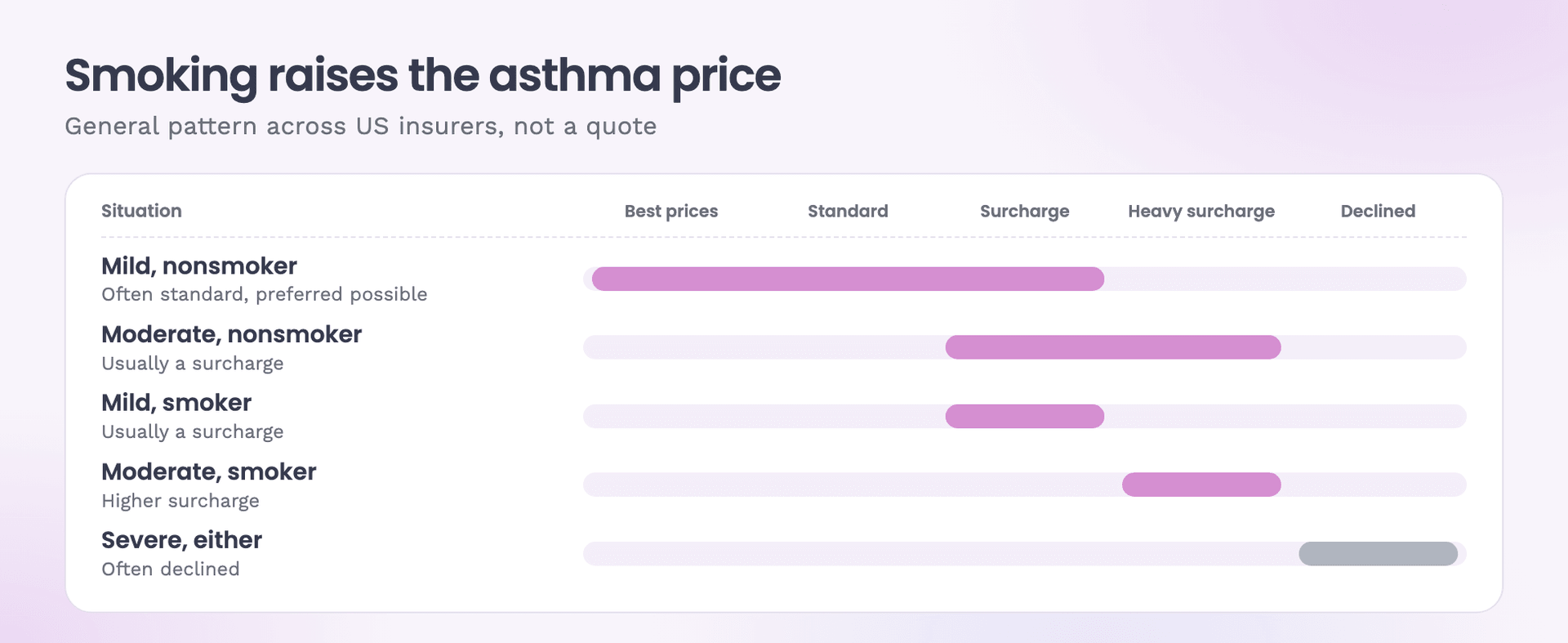
If you've quit, the length of time matters. Our guide to when non-smoker rates may apply explains the usual waiting periods.
What questions will insurers ask about your asthma?
Fully underwritten applications usually ask for the same handful of facts:
- Number of attacks in the past 12 months. This is one of the clearest signs of how well controlled your asthma is.
- Date of your last attack. It shows whether the pattern is recent or in the past.
- Hospitalizations, and when the last one was. An admission years ago counts for much less than a recent or repeated one.
- Current medications and treatment. An occasional rescue inhaler tells a different story than a daily controller or repeated courses of oral steroids.
- Triggers and pattern. Seasonal or exercise-induced asthma is often described as milder than symptoms that come on year-round.
You can prepare for these before you apply. Write down your attack count, the date of your last flare, any hospital visits and your medication list. Ask your doctor for a copy of your records if you want to check them. Clear, accurate answers speed up a file. Vague ones leave the underwriter to guess.
Life insurance for COPD: why the label on your record matters
Asthma and COPD (chronic obstructive pulmonary disease) are different conditions, though they can overlap, especially in older adults and people with a smoking history. Underwriting guides treat them separately. If your records say COPD, the chronic lung disease rules usually apply instead of the asthma rules, and those are stricter. One simplified-issue guide says so directly.
Mislabeling does happen. If you think a COPD entry on your chart is wrong, ask your doctor about it. Whether it is correct is a medical question, and your doctor is the right person to answer it. Don't ask anyone to change a diagnosis to help an application.
Can children or newly diagnosed adults get life insurance with asthma?
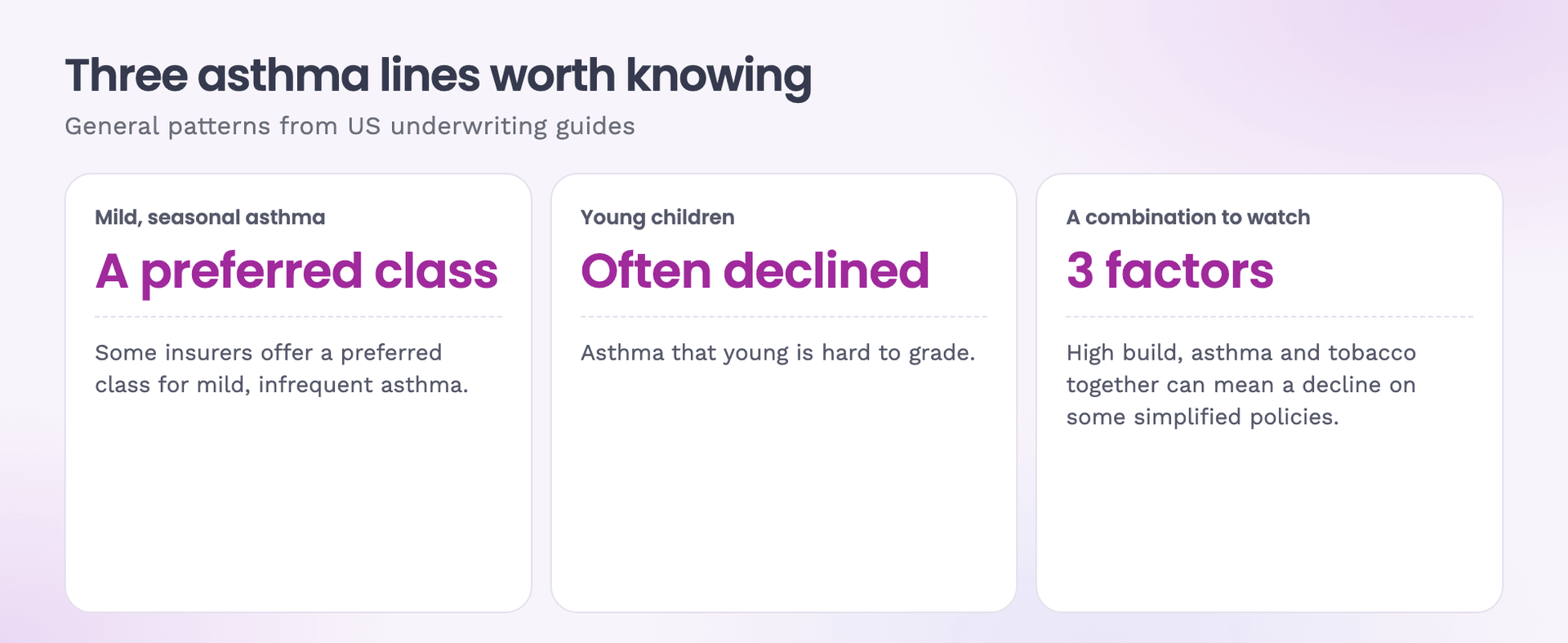
Parents sometimes ask about juvenile policies. Insurers that price childhood asthma often decline very young children, because asthma at that age is hard to grade and can change quickly. For older children, mild asthma that was diagnosed some time ago can be rated near standard, and anything more serious may be declined. These rules vary by insurer, so ask for a quote rather than assuming.
For adults, a long history of mild, stable asthma gives an underwriter more to work with than a recent diagnosis that is still being sorted out. How recent the diagnosis is and how settled your treatment is can both affect the decision.
Life insurance options if you have asthma: fully underwritten vs. no-exam
Fully underwritten policies involve health questions, often an exam, and a review of your medical records. This is where mild, controlled asthma can earn the best prices, because the underwriter can see the full picture.
No-exam policies skip the medical exam, but they can still ask health questions and check prescription and medical information records. In the simplified-issue guides we reviewed, mild or moderate asthma was not a barrier. Chronic or severe asthma is listed as a common impairment, but it isn't asked about directly on the application, and the outcome depends on the product. Some policies start benefits at a reduced level for the first couple of years instead of declining, so read the terms.
One combination is worth knowing about. On at least one simplified-issue guide, a higher-than-average build together with asthma and tobacco use leads to a decline, even though each factor alone does not. Insurers tend to forgive single issues and look harder at clusters. If weight is part of your picture, see our guide to build and BMI.
Eleos offers no-exam term life insurance for most applicants, with an online application. That can be a practical choice if your asthma is mild or moderate. If you have severe asthma or recent hospital stays, talking to an adviser first usually makes more sense. If you later want fully underwritten pricing, you can look at replacing the policy once things have settled. Keep the old policy in force until the new one is approved.
How to lower your life insurance rates with asthma
- Know your numbers. Attacks in the past 12 months, last attack date and hospital history. Accurate answers matter more than good ones.
- Describe your treatment accurately. Say whether you use a rescue inhaler only, a daily controller or both, and how often.
- Consider timing. A recent emergency visit or steroid course will be weighed heavily. Some insurers look for a waiting period of a year or more after a serious flare. Never change or delay treatment to suit an application. That is a decision for you and your doctor.
- If you use tobacco, expect it to count. Tobacco affects price on its own and can raise the asthma rating.
- Check your records. Look for a COPD label and other entries that don't match your history.
- Compare insurers. Mild asthma can be rated differently from one company to the next, and a rated offer from one is not a verdict from all.
Asthma can also show up alongside other conditions, and insurers look at the pattern as a whole. If breathing at night is an issue, our guide to life insurance with sleep apnea may help. If there are heart concerns, see life insurance with heart disease.
Questions people ask
Can you get life insurance with asthma? Usually, yes. Mild and moderate asthma are commonly insurable, often at a standard price or with a table rating. Severe asthma is the case most likely to be declined or postponed.
What disqualifies you from getting life insurance? No single rule applies everywhere. With asthma, the cases most likely to be declined are severe or persistent asthma, recent or repeated hospital stays, and records that show COPD. Combinations count too, such as asthma with a high build and tobacco use on some simplified policies.
Can I get a preferred price class with asthma? Sometimes. In the guides we reviewed, mild, infrequent asthma, such as the seasonal or exercise-induced kind, is eligible for a preferred class at some insurers, and mild asthma on one or two medications can reach one at others. Other insurers start mild asthma at Standard.
I only use my inhaler before exercise. Do I need to mention it? Yes. If the application asks about asthma or your medications, answer truthfully. Exercise-induced asthma that is well controlled is one of the milder profiles.
My asthma went away years ago. Do I still declare it? If the application asks about your history, answer it with dates. Most life insurance policies have a contestability period, generally two years and set by state law, during which an insurer can review the application if a claim is made. A material misstatement can lead to a denied claim or a canceled policy.
Do steroid tablets matter more than inhalers? Often, yes. Repeated courses of oral steroids usually suggest that asthma is breaking through treatment, and underwriters tend to read them that way. A single course in the past is usually weighed less.
What if my record says COPD and I have asthma? Underwriters go by what the medical record says. If you think it's wrong, raise it with your doctor.
How much coverage should I get? That depends on your debts, income and family, not on your asthma. Our guide to how much term life insurance you need walks through it by life stage.
Can Eleos Life help if you have asthma?
Yes. Eleos Life helps people with asthma find life insurance in every US state except New York. We're a licensed insurance producer working with multiple A-rated insurers, so you aren't limited to one insurer's rules. That matters because insurers judge asthma differently, and one no isn't the last word.
We can help in two ways:
- Fully underwritten coverage: an insurer reviews your full health history. This route offers the highest coverage amounts and the best chance of a fair price. Get a quote below, or talk to a licensed adviser at +1 888 998 1020.
- Guaranteed-issue coverage: no medical exam and no health questions, if underwritten coverage isn't available. Coverage amounts are lower, a waiting period applies, and availability varies by state.
We can't promise an offer from any one insurer, but we can show you which routes are open to you.

The bottom line
Asthma is priced by severity. How often you have attacks, how long since the last one, whether you've been hospitalized, what treatment you need and whether you use tobacco all play a part, and so does the label on your record. Know your facts, check your records and compare more than one insurer. Mild, well-controlled asthma is a manageable underwriting issue, and the right policy is usually available.
See what your price looks like. If your asthma is mild or moderate, an Eleos quote takes minutes. If it is severe, talk to an adviser about your options first.
This guide describes how life insurance underwriting generally works, based on the underwriting rules of the insurers Eleos works with. It isn't advice and it isn't a quote. Individual outcomes depend on your full application. Figures are indicative and current as of November 2026. Questions about your asthma and its treatment are matters for your doctor.
Fact-checked and reviewed by Kiruba Shankar Eswaran or another licensed agent on our team. Read our editorial standards.
This guide is for general educational purposes and is not insurance advice. Product features, availability, and amounts vary by state and by policy. Always review the official plan documents for the full terms, limitations, and exclusions before you buy.
Related resources

Life insurance after a DUI: how long insurers look back
A DUI is priced mostly by time since the offense, the number of offenses and license status. This guide explains look-back periods, flat extras and how to choose a route.

Life insurance with sleep apnea: how CPAP use affects your rate
Sleep apnea rarely blocks life insurance. This guide explains how severity and treatment records shape your rate and which application route to consider.

Life insurance with depression and anxiety: how insurers judge severity
How US life insurers sort depression and anxiety into mild, moderate and severe, what moves your price, and how fully underwritten and no-exam routes differ.

Life insurance with high cholesterol: the full picture
How high cholesterol and statins affect life insurance: what insurers measure, where their limits sit, and how to get a better price.

Life insurance after cancer: waiting periods and options
Cancer history doesn't automatically rule out life insurance. Insurers look at type and stage, time since treatment, and recurrence or spread, and their waiting periods vary widely.