Life insurance with sleep apnea: how CPAP use affects your rate


Short answer: sleep apnea usually doesn't stop you from getting life insurance. Treated, well-controlled apnea can be priced at or near standard rates, and at some insurers mild cases can reach a preferred class. Untreated or severe apnea is where prices rise and some applications are postponed or declined. Rules differ from insurer to insurer.
Life insurance with sleep apnea is unusual because the condition comes with its own evidence. Most CPAP machines record how many hours you use them each night. Insurers know this, so apnea underwriting is less about the diagnosis itself and more about the treatment record behind it.
This guide covers how insurers grade severity, what treatment can do for your price, the oxygen question that trips people up, and which route to take. If you're new to this type of coverage, start with what term life insurance is.
Is it hard to get life insurance with sleep apnea?
Usually not. In obstructive sleep apnea, breathing pauses repeatedly during sleep. Over time, untreated apnea is linked to higher blood pressure, heart disease, stroke and drowsy-driving accidents. Insurers price for those risks.
That is why treatment matters so much. Someone whose apnea is controlled has reduced much of the risk the insurer is worried about. Someone who was diagnosed but isn't using treatment has not. Your doctor is the right person to talk to about your treatment. This guide only explains how insurers read the record.
How does sleep apnea affect life insurance rates?
Doctors grade apnea by the apnea-hypopnea index (AHI), the number of breathing pauses per hour of sleep:
- Mild: 5 to under 15 events an hour
- Moderate: 15 to under 30
- Severe: 30 or more
The guides we reviewed follow these grades closely. In general, mild apnea can be priced at standard rates. Moderate apnea usually lands at standard or a modest table rating. Severe apnea is where the range widens most: a heavier rating, or a decline or postponement.
Table ratings add a percentage to the standard price, and at many insurers each step adds about 25 percent. A rating of Table 4 means roughly double. So severe, poorly controlled apnea is not a small surcharge. It can double a premium or close the application.
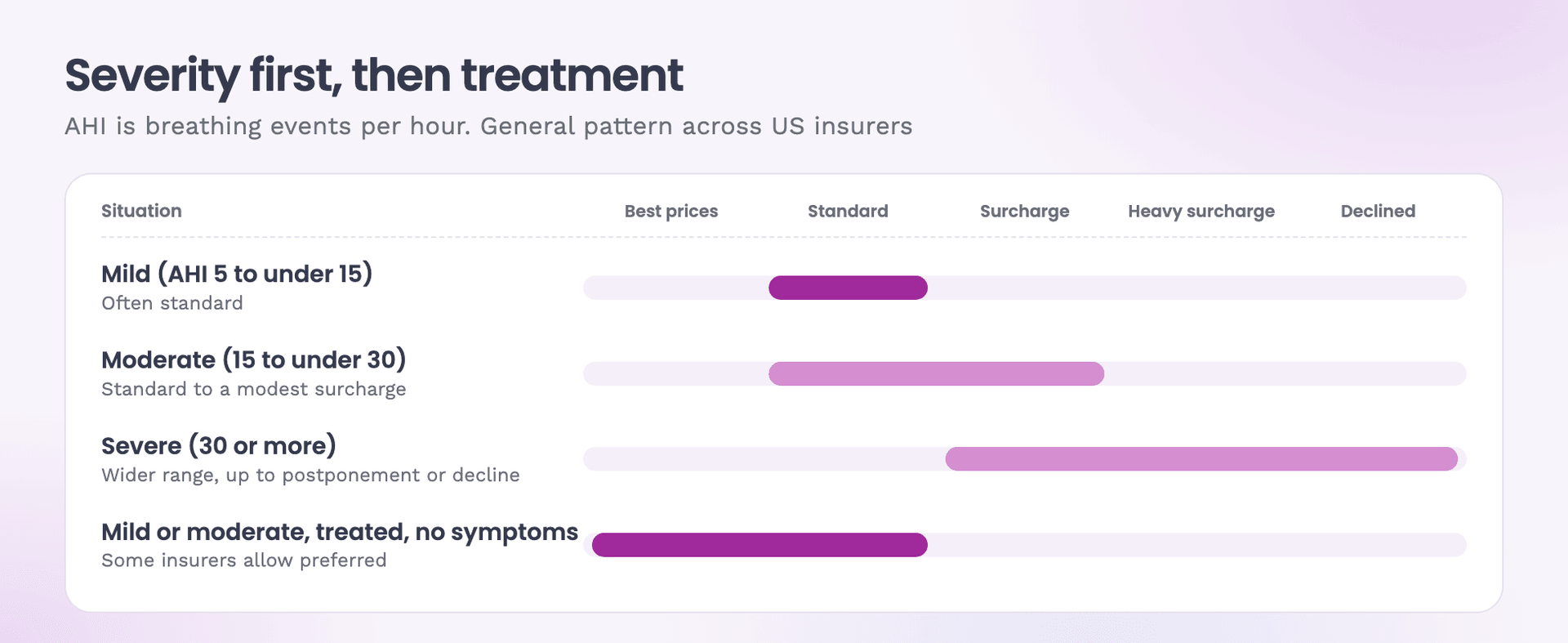
Treated apnea moves the picture. One fully underwritten insurer says successfully treated apnea is rated anywhere from standard up to a modest table rating, depending on the record.
How to lower your rates with sleep apnea treatment
This is the encouraging part. Two guides spell it out:
- One says mild sleep apnea may be eligible for a preferred class with verified CPAP usage.
- Another allows its best class for mild or moderate apnea that is compliant with treatment and has no residual symptoms.
The word "verified" matters. A usage report from your machine turns "I use it every night" into a documented fact.
The opposite also matters. A sleep study showing significant apnea, followed by no sign of treatment, is the file that leads to the heavier ratings. Insurers can't see your bedroom, but they can read your records and your prescription history.
If you stopped using treatment, or never started, talk to your doctor. Don't change your treatment to look better on an application. Treatment decisions are medical decisions.
What do insurers ask about CPAP, oxygen and symptoms?
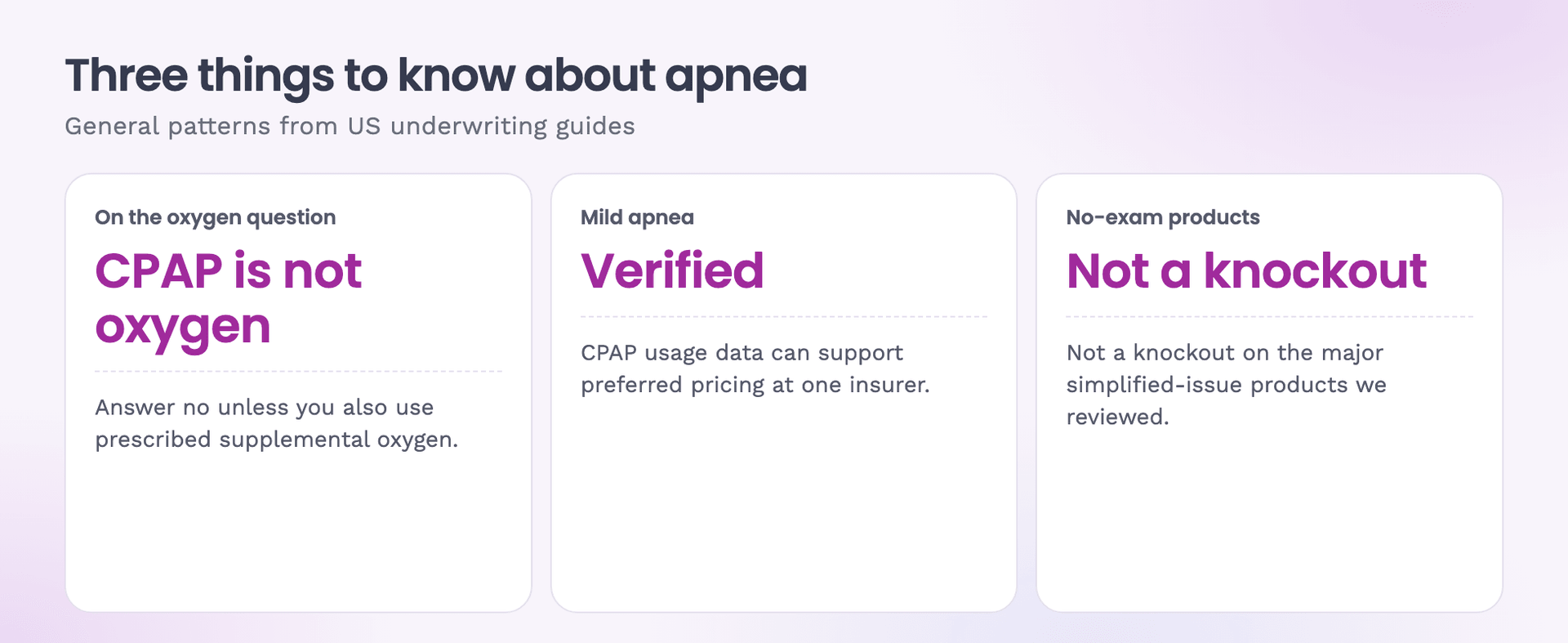
CPAP is not oxygen use. Many applications ask whether you use oxygen. A CPAP machine pushes room air, so it doesn't count. Underwriting guidance we reviewed says so directly, and one no-exam insurer says oxygen used only for sleep apnea doesn't count as oxygen use. If your doctor has prescribed supplemental oxygen along with CPAP, that is different, and you should say so. Answering "yes" by mistake can make a simple application look much more serious than it is.
Untreated apnea with symptoms is the hardest file. Snoring alone is not the issue. A high AHI, no treatment, and symptoms such as excessive daytime sleepiness or drowsy driving are what push cases toward higher ratings or declines.
Apnea is rarely priced alone. It often travels with extra weight, high blood pressure and heart conditions, and underwriters look at the whole pattern. Controlled apnea with everything else in order is a small story. Apnea alongside high blood pressure and a high BMI is a bigger one. If heart problems are part of your history, see our guide to life insurance with heart disease. If you also have asthma, it's reviewed alongside your apnea. Because of this, it helps to show every item in the pattern as controlled.
What types of life insurance are available if you have sleep apnea?
Fully underwritten policies use a medical exam or your medical records. This is where your compliance data can earn a better class. If you have mild or moderate apnea, you use treatment consistently and your symptoms are gone, fully underwritten quotes are worth a look.
Simplified-issue and no-exam policies skip the exam but still ask health questions, and they can check prescription and medical information records. In the guides we reviewed, sleep apnea is not a knockout question on the major products of this type. Other conditions on the application can still lead to a decline, so answer every question honestly.
A sensible approach:
- Mild or moderate apnea, treated, with records to show it: get fully underwritten quotes and compare them.
- Newly diagnosed, treatment still settling, or severe: a no-exam policy can get you covered sooner. Once you have a longer record of treatment, you can look at fully underwritten quotes. If you replace a policy, keep the old one in force until the new one is approved, and remember the new one is priced at your older age.
Eleos offers no-exam term life insurance, with no medical exam for most applicants and an online application that takes about 15 minutes.
Honesty matters here. Most life policies have a contestable period, generally two years and varying by state, during which the insurer can look into whether the application was accurate. Applications that leave out a diagnosis or treatment can lead to a denied claim.
How to build the strongest sleep apnea application
- Get your sleep study results. Know your AHI at diagnosis, and a recent one if you have it.
- Ask about a usage report. Most CPAP machines and their apps can produce one. Months of consistent use are the most useful document in an apnea application. Ask your doctor or the insurer what level of use counts as compliant.
- Document how you feel. Notes that show no residual daytime sleepiness support the best classes.
- Keep your treatment going as your doctor directs. A gap in use shows up in the record.
- Look at the whole picture. Weight and blood pressure readings that improve, with your doctor's guidance, strengthen the whole application.
- Answer the oxygen question accurately. CPAP alone is not oxygen. Prescribed supplemental oxygen is.
Questions people ask
Can you get preferred pricing with sleep apnea? Sometimes. Some guides allow preferred classes for mild or mild-to-moderate apnea when treatment use is verified or documented and symptoms are gone. Other factors on your application still count, and not every insurer allows it.
What if I was diagnosed but never used the machine? Expect the higher end of the range: table ratings, and at the severe end, postponement or a decline. Talk to your doctor about treatment. A longer record of consistent use can change how a file reads.
Does a home sleep test count, or do I need a lab study? Both are used in diagnosis. Underwriters mainly look at the AHI grade and your treatment record afterward.
I use an oral appliance, not CPAP. Does that count as treatment? It may. Treatment decisions belong with your sleep specialist, so ask your doctor for follow-up results that show how well it works and bring them to the application. How an insurer weighs this varies.
My apnea is severe but treated. Where do I land? Often in the middle of the range, from standard to a table rating at some insurers, depending on your records and the rest of your health. Comparing several insurers is especially useful here.
What is AHI, and why do insurers ask about it? AHI is the apnea-hypopnea index, the number of breathing pauses per hour of sleep, found on your sleep study. Insurers use it to grade severity as mild, moderate or severe.
What is the cheapest life insurance with sleep apnea? There isn't one answer. Price depends on your severity, treatment record, age and the rest of your health, and insurers weigh apnea differently. Comparing several insurers is the most reliable way to find the lowest price you qualify for.
How much coverage should I get? That depends on your debts, income and family, not your sleep apnea. Our guide to how much term life insurance you need walks through it.
Can Eleos Life help if you have sleep apnea?
Yes. Eleos Life helps people with sleep apnea find life insurance in every US state except New York. We're a licensed insurance producer working with multiple A-rated insurers, so you aren't limited to one insurer's rules. That matters because insurers judge sleep apnea differently, and one no isn't the last word.
We can help in two ways:
- Fully underwritten coverage: an insurer reviews your full health history. This route offers the highest coverage amounts and the best chance of a fair price. Get a quote below, or talk to a licensed adviser at +1 888 998 1020.
- Guaranteed-issue coverage: no medical exam and no health questions, if underwritten coverage isn't available. Coverage amounts are lower, a waiting period applies, and availability varies by state.
We can't promise an offer from any one insurer, but we can show you which routes are open to you.
The bottom line
Sleep apnea is serious when ignored and far more manageable when treated, and your treatment record can show it. Understand your severity, keep your usage records, answer the oxygen question correctly and compare insurers. Follow your doctor's advice on treatment, and the diagnosis may cost you much less than you expect.
See what your price looks like. Eleos quotes take minutes, need no medical exam for most applicants, and carry no obligation.
This guide describes how life insurance underwriting generally works, based on the underwriting rules of the insurers Eleos works with. It isn't advice and it isn't a quote. Individual outcomes depend on your full application. Figures are indicative and current as of November 2026. Sleep apnea diagnosis and treatment decisions are matters for your doctor.
Fact-checked and reviewed by Kiruba Shankar Eswaran or another licensed agent on our team. Read our editorial standards.
This guide is for general educational purposes and is not insurance advice. Product features, availability, and amounts vary by state and by policy. Always review the official plan documents for the full terms, limitations, and exclusions before you buy.
Related resources

Life insurance after a DUI: how long insurers look back
A DUI is priced mostly by time since the offense, the number of offenses and license status. This guide explains look-back periods, flat extras and how to choose a route.

Life insurance with depression and anxiety: how insurers judge severity
How US life insurers sort depression and anxiety into mild, moderate and severe, what moves your price, and how fully underwritten and no-exam routes differ.

Life insurance with asthma: what insurers look at
How US life insurers judge asthma by severity, attacks, treatment and tobacco use, why a COPD label matters, and whether to apply fully underwritten or no-exam.

Life insurance with high cholesterol: the full picture
How high cholesterol and statins affect life insurance: what insurers measure, where their limits sit, and how to get a better price.

Life insurance after cancer: waiting periods and options
Cancer history doesn't automatically rule out life insurance. Insurers look at type and stage, time since treatment, and recurrence or spread, and their waiting periods vary widely.