Life insurance after a stroke or TIA: what insurers look at


Short answer: a stroke or TIA does not always mean a decline, but it does limit your options. Insurers usually look at three things: how many events you've had, how long ago the last one was, and how well you recovered. A single TIA or a well-recovered stroke from some years back can often be insured, sometimes at a higher price. A recent, severe or repeated stroke is often declined or postponed.
Life insurance after a stroke or TIA is often possible, though your options depend on your details and on which insurer you ask. A stroke is a loss of blood flow to part of the brain, or bleeding in the brain, that damages brain tissue. A TIA, often called a "mini-stroke," has the same cause but the symptoms go away, usually within an hour or so. Most strokes are ischemic, meaning a blocked blood vessel. If you're new to this type of coverage, start with what term life insurance is.
This guide explains the three factors, which we'll call dials, along with how insurers treat a stroke combined with other conditions and which routes may be open to you. It is general information, not medical advice. Your care team's plan always comes first.
Why does recurrence risk matter to insurers?
A TIA leaves no lasting damage, so it can seem odd that it affects your price. The reason is what it predicts. The CDC says as many as 10% to 15% of people have a major stroke within three months of a TIA. Insurers aren't pricing the TIA itself. They are pricing the chance of a later stroke.
That is why a TIA is usually treated as a real event, not as nothing. It is also usually priced more gently than a stroke.
Can you get life insurance after a stroke? The first dial: how many events
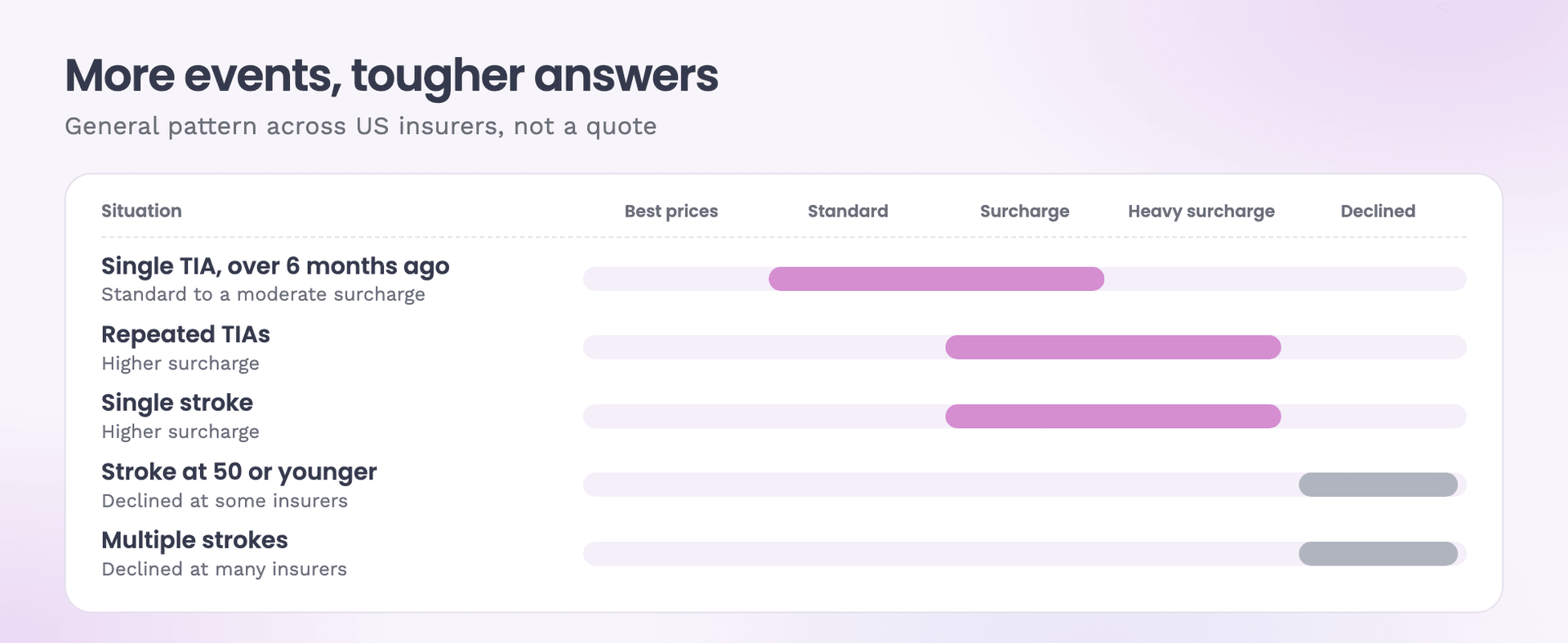
The number of events is the biggest factor. The pattern across the guides we reviewed is consistent:
- One TIA more than six months ago is often offered at a standard price or with a moderate surcharge.
- Repeated TIAs usually bring a larger surcharge.
- One stroke more than six months ago is usually considered with a rating, and the surcharge can be substantial.
- Multiple strokes are declined or postponed at many insurers.
A rating, or table rating, is a surcharge on the standard price. Each table step adds roughly 25 percent. A stroke can also come with a flat extra, which is a fixed charge per $1,000 of coverage added on top of the rating. Some insurers use one, and it may last for a set number of years or for the life of the policy. If you receive a rated offer, ask whether it includes a flat extra, how much it is per $1,000, and how long it lasts.
Age at the event matters too. Some insurers decline a stroke at age 50 or younger, and consider an older age at the event differently. This gate differs from one insurer to the next. If your stroke was at a younger age and one insurer declined you for that reason, another may look at the case differently.
The second dial: how long do you have to wait after a stroke or TIA?
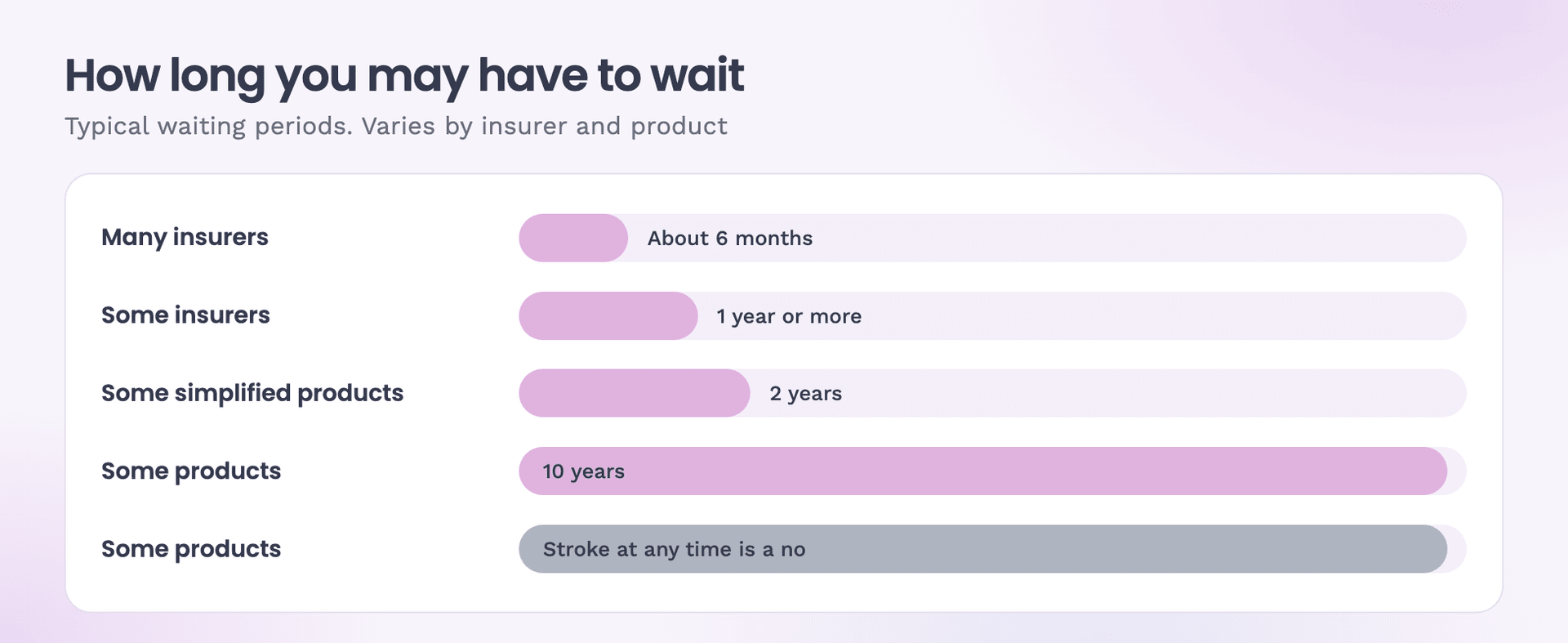
Time since the event is usually the first gate. For a recent event, the market is close to closed:
- Many insurers won't offer coverage within about six months of a stroke or TIA. Some list a recent stroke as uninsurable.
- Some insurers want a year or more before they will consider a stroke.
- Some simplified-issue products look back two years. A stroke diagnosed, treated or advised on within that window is a no, and a stroke with no related treatment since may be a yes.
- Some products look back ten years and decline any stroke or TIA inside that window. Others decline a stroke at any time.
Read "no related treatment since" carefully. Some products define treatment broadly, to include follow-up visits, therapy and prescriptions. Ask how the term is defined before you assume your clock has run out.
If you are inside a waiting period, keep following your doctor's plan. Your health comes first, and a clean recovery record is useful whenever you do apply.
The third dial: how severe was the stroke?
After a stroke, insurers think about severity in terms of function. They are less interested in what a scan shows than in how you live now. In the guides we reviewed, a stroke that leaves impaired thinking, wheelchair use or a need for help with daily activities is typically declined. A stroke with a good recovery, where you are independent and back to your usual activities, is more likely to be considered with a rating.
Underwriters reconstruct your function from documents. Records that show a good recovery help, such as:
- Hospital discharge and neurology notes
- Therapy completion
- A return to work and to normal activities
- A statement of no remaining deficits, if your doctor can give one
When other conditions are in your file
The same events look different depending on what else is in your file. Insurers tend to treat the following as part of the same pattern:
- Diabetes. Some simplified-issue products decline a stroke combined with diabetes on the standard benefit plan, but accept it on a graded plan, which pays a reduced benefit in the early years. The graded plan is a different product with different terms, so a "no" on one plan is not always the end of the road.
- High blood pressure. This is a major cause of stroke, and underwriters will look at how well it is controlled.
- High cholesterol. Treated cholesterol is common after a stroke. Controlled numbers help.
- Heart disease. Atrial fibrillation or other heart conditions, if they caused the stroke, are part of the picture.
- Tobacco. If you smoke, that is priced separately, and quitting can change which rates apply.
A stroke with an identified cause that has been treated may be easier for an underwriter to assess than one with an unknown cause. Underwriters want to know what was done about the cause.
What a strong stroke file looks like
- The event, precisely. The date, the type (ischemic or hemorrhagic), the cause if found, and what was done about it.
- The recovery, documented. Any remaining effects or none, in your doctor's words, with therapy completed.
- The quiet years. No further events or new symptoms, and follow-up appointments attended.
- The cause, controlled. Blood pressure, cholesterol, atrial fibrillation and diabetes managed as your doctor advises.
- The count, accurate. One event is one event. Insurers can check prescription and medical records, and an undisclosed TIA that comes to light later can cause serious problems. In the US, a policy is generally contestable for about two years, and insurers can rescind or deny a claim over a material misstatement during that time. The period varies by state.
Your coverage options: underwritten, no-exam and guaranteed-issue
Fully underwritten policies involve your medical records and often an exam. This is where the most flexibility sits. Insurers that price strokes case by case do so here, and a good recovery record gets full credit. For most stroke histories, this is the realistic route, and a licensed adviser can show you which insurers are likely to be more open.
Simplified-issue and no-exam policies skip the exam, but they can still ask health questions and check prescription and medical information records. Stroke and TIA are common questions on these applications, and a yes often leads to a decline or a reduced benefit. Whether a no-exam product works for you depends on how long ago the event was and on the specific questions asked, so answer every question honestly.
Guaranteed-issue policies ask no health questions. Coverage amounts are small, and they usually pay a reduced benefit in the first couple of years. They can still be a useful option when other routes are closed.
Eleos offers no-exam term life insurance online, but for a stroke or TIA history we suggest starting with a licensed adviser. No-exam routes often decline these histories, so an adviser can point you to the insurers most likely to consider your case.
If your stroke or TIA has affected your ability to work, disability insurance is a separate type of coverage, and it has its own health questions.
Questions people ask
A TIA left no damage. Why am I being charged extra? Because insurers price what a TIA predicts, not what it did. A TIA is a warning sign for a later stroke. The charge is usually modest compared with the rating for an actual stroke, and some single TIAs more than six months old are offered at or near a standard price.
How soon after a stroke can I apply? You can apply at any time, but many insurers won't offer coverage within about six months, and some want a year or more. After that, the answer depends on severity, age at the event and the insurer. If you are inside a waiting period, a licensed adviser can tell you which insurers are worth approaching and when.
My stroke was at 47. Is it final? A decline at one insurer is not final. Some insurers decline a stroke at age 50 or younger. Insurers don't all set the same age gate, so another may review the full case. It narrows your options, but it doesn't remove them.
Does a flat extra ever end? It can. Some are charged for a set number of years, and the terms are spelled out in the offer. Get the length in writing before you accept. A rated offer with a flat extra and one without are different products with the same label.
I had a stroke years ago and nothing since. Is there a simple route? Possibly. Some simplified-issue products accept a stroke after two years with no related treatment since, and no diabetes. Others look back ten years or decline a stroke at any time. Check each product's wording, because definitions of treatment vary.
Can I get life insurance after a stroke if I'm a senior? Age alone doesn't disqualify you. Insurers weigh the same factors: number of events, time since, recovery and other conditions. Your age at the event also matters, and policies have their own age limits. Our guide to term life insurance for seniors covers the basics.
What if I already have coverage? A policy already in force generally stays in force, and a later stroke doesn't change it. Keep it until any new policy is approved and in force, and ask an adviser before replacing it.
How much coverage should I get? That depends on your debts, income and family, not your diagnosis. Our guide to how much term life insurance you need walks through it by life stage.
Can Eleos Life help if you've had a stroke or TIA?
Yes. Eleos Life helps people with a history of stroke or TIA find life insurance in every US state except New York. We're a licensed insurance producer working with multiple A-rated insurers, so you aren't limited to one insurer's rules. That matters because insurers judge a history of stroke or TIA differently, and one no isn't the last word.
We can help in two ways:
- Fully underwritten coverage: an insurer reviews your full health history. This route offers the highest coverage amounts and the best chance of a fair price. Talk to a licensed adviser at +1 888 998 1020, or start with a quote below.
- Guaranteed-issue coverage: no medical exam and no health questions, if underwritten coverage isn't available. Coverage amounts are lower, a waiting period applies, and availability varies by state.
We can't promise an offer from any one insurer, but we can show you which routes are open to you.
The bottom line
A stroke or TIA is insurable more often than people expect, but the answer depends on how many events you've had, how long ago, and how well you recovered. A single TIA or a well-recovered stroke from some years ago is the best case. A recent, severe or repeated stroke is the hardest. Compare insurers, keep your recovery records, and answer every question accurately.
Check your options or talk to an adviser. There's no obligation, and you'll be asked about your stroke or TIA.
This guide describes how life insurance underwriting generally works, based on the underwriting rules of the insurers Eleos works with. It isn't advice and it isn't a quote. Individual outcomes depend on your full application. Figures are indicative and current as of November 2026. Questions about your recovery, treatment and risk of another stroke are matters for your doctor.
Fact-checked and reviewed by Kiruba Shankar Eswaran or another licensed agent on our team. Read our editorial standards.
This guide is for general educational purposes and is not insurance advice. Product features, availability, and amounts vary by state and by policy. Always review the official plan documents for the full terms, limitations, and exclusions before you buy.
Related resources

Life insurance after a DUI: how long insurers look back
A DUI is priced mostly by time since the offense, the number of offenses and license status. This guide explains look-back periods, flat extras and how to choose a route.

Life insurance with sleep apnea: how CPAP use affects your rate
Sleep apnea rarely blocks life insurance. This guide explains how severity and treatment records shape your rate and which application route to consider.

Life insurance with depression and anxiety: how insurers judge severity
How US life insurers sort depression and anxiety into mild, moderate and severe, what moves your price, and how fully underwritten and no-exam routes differ.

Life insurance with asthma: what insurers look at
How US life insurers judge asthma by severity, attacks, treatment and tobacco use, why a COPD label matters, and whether to apply fully underwritten or no-exam.

Life insurance with high cholesterol: the full picture
How high cholesterol and statins affect life insurance: what insurers measure, where their limits sit, and how to get a better price.

Life insurance after cancer: waiting periods and options
Cancer history doesn't automatically rule out life insurance. Insurers look at type and stage, time since treatment, and recurrence or spread, and their waiting periods vary widely.