Life insurance with depression and anxiety: how insurers judge severity


Short answer: yes, you can usually get life insurance with depression or anxiety. Insurers mostly look at how severe the condition is, how it is treated, how much it affects your daily life and work, and how long you have been stable. Mild, well-controlled cases can be priced at or near standard rates. Moderate cases usually cost more. Severe cases, or a recent hospital stay, may be postponed or declined for now.
Applying for life insurance with depression and anxiety is common. In 2022, about 23% of US adults, or roughly 59 million people, had some form of mental illness, according to the National Institute of Mental Health. Anxiety and depression are among the most common. Many people with a diagnosis assume life insurance is out of reach, or worry about being denied.
Underwriters mostly ask one question: how much does the condition affect your life? They look at medications, time away from work, hospital stays and how long things have been steady. This guide explains how that works and how to approach an application. If you're new to this type of coverage, start with what term life insurance is.
If you are struggling right now, help is available. In the US, you can call or text 988 to reach the 988 Suicide & Crisis Lifeline at any time.
Does having depression disqualify you from life insurance?
Not by itself. Underwriting guides generally sort anxiety and depression into three broad groups, mild, moderate and severe. The exact wording differs by insurer, and each insurer makes its own decision on your full file.
Mild. The condition is stable. You haven't missed work because of it. You take no more than one medication, at a modest dose, or none at all. There has been no hospital stay and no alcohol or drug problem. At some insurers, a case like this can reach standard rates, and the better preferred classes are possible. A few insurers will consider their very best class for mild anxiety that is well controlled on one medication, or for a single, short episode of depression that has ended and needs no current medication.
Moderate. Treatment is working, but the condition has had more impact. You may see a therapist, and you may have missed a short stretch of work, a week or two in total. Moderate cases usually land between standard and a table rating. Anxiety often rates a little higher than depression at this level, though the ranges overlap.
Severe. The condition is disabling, keeps you from working, or has needed repeated hospital care. Many insurers will postpone or decline at this level. Some will still offer coverage at a heavily rated price after a long period of stability.
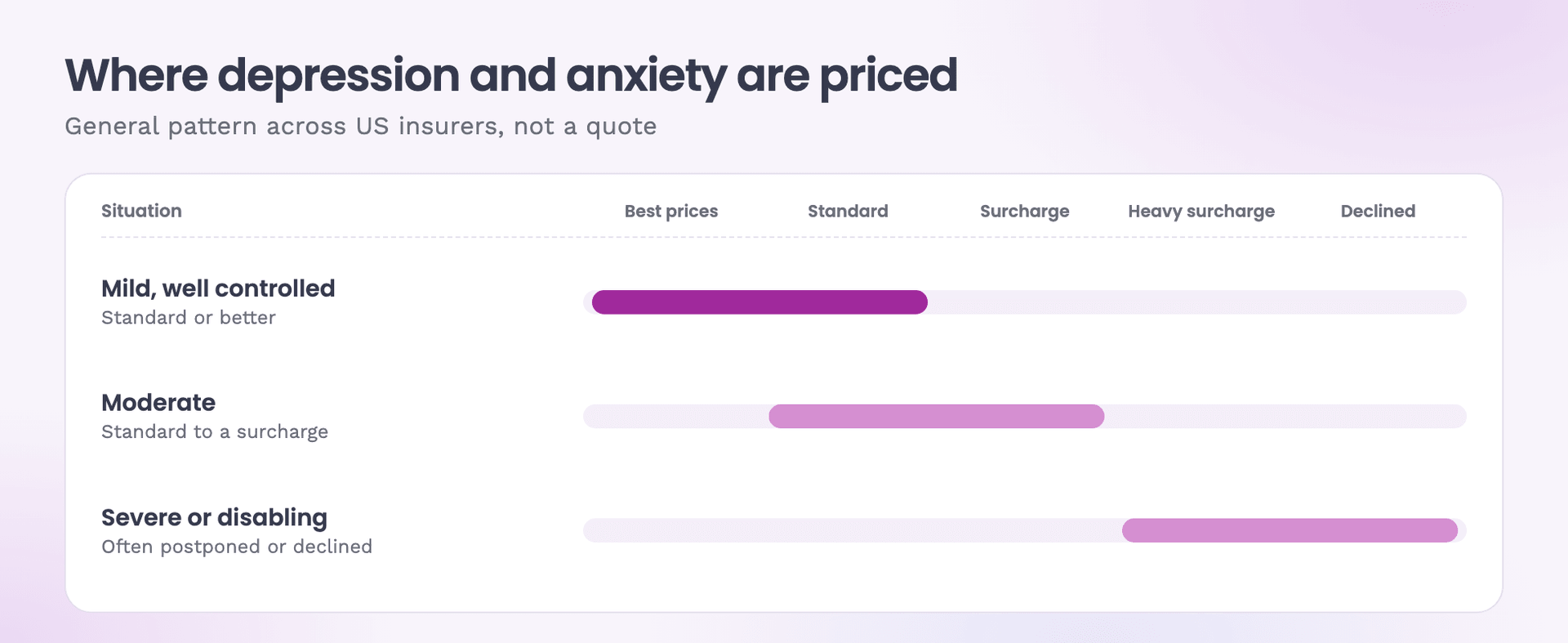
How do depression and anxiety affect life insurance rates?
A table rating is a surcharge added to the standard price. Each table step adds roughly 25 percent. Table 2 is about 50 percent more than standard, and Table 4 is about double. Here is an illustration, not a quote. If standard pricing is $50 a month, Table 2 would be about $75 and Table 4 about $100. A moderate case at a mid-range rating costs real money, but it is a price, not a refusal. The same file can also be rated differently by different insurers, so comparing quotes matters.
What do underwriters look at?
Underwriters don't score your mood. They look at evidence in your records. A few items do most of the work.
Medications. One medication, well controlled, is usually seen as the mildest picture. Two or more, or certain stronger drugs, can move you up a step. Frequent changes may suggest the condition isn't settled yet. Insurers check prescription records, so your medication history will be visible to them.
Time away from work. Guides often count it. No lost time points to mild. A short absence points to moderate. Being unable to work points to severe.
Hospital stays. An inpatient stay for a mental health condition is usually the heaviest single factor. How long ago it happened, and how you have done since, both matter.
Suicide attempts and self-harm. Insurers treat these with particular care. A recent attempt, often within the last couple of years, can lead to a postponement. Multiple attempts can lead to a decline. Time and a stable recovery are what change the answer, and some insurers consider an attempt in the more distant past at standard or slightly rated prices. If this is part of your history, answer honestly and consider talking with a licensed agent before you apply.
Stability. Every guide rewards the same pattern: the same treatment, working, for a good stretch of time, with work and daily life steady. Longer stability generally helps, and some insurers look for a waiting period of a year or more after a major event.
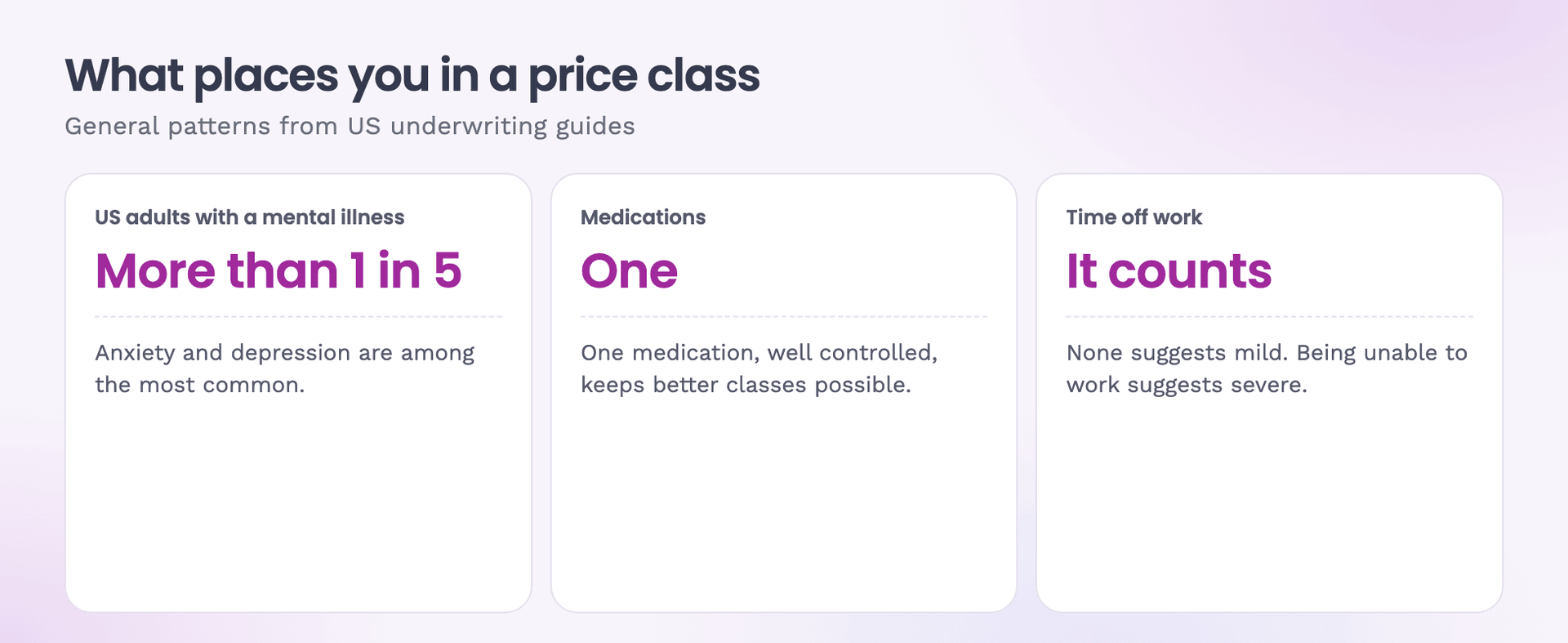
Does anxiety or depression treatment affect your price?
It can seem odd, but treatment can have a small effect on the very top price class. Some insurers reserve their best class for people who have never needed treatment, and allow only stable, mild cases at the class below. That is a difference of one class at some insurers.
Treatment still helps overall. An untreated moderate or severe condition looks worse to an underwriter than a treated mild one. Treatment is also the evidence that a condition is under control. Decisions about medication and therapy belong to you and your doctor. Never start, stop, change or delay treatment to improve an application.
What other health factors do insurers consider?
Mental health is usually reviewed alongside the rest of your file. Some conditions often appear together. Sleep apnea and epilepsy are two, and heart health is another, so you may also want to read about life insurance with heart disease. If alcohol has been part of your history, see life insurance after a DUI. Insurers look at those things together, and a strong record elsewhere can help.
Other options if you've been denied: fully underwritten or no-exam
Fully underwritten policies can involve a medical exam, a review of your medical records or both. This is where the mild, moderate and severe sorting is applied most closely. If your history is mild and stable, this route can give you the best price.
Simplified issue and no-exam policies skip the exam, but they can still ask health questions. They can also check prescription and medical information records, so answer every question honestly. How they treat mental health varies a lot:
- Some do not ask about depression or anxiety at all, unless you have had a hospital stay for a mental or nervous condition in roughly the last two years.
- Some ask about any mental illness a doctor has diagnosed or treated, including depression or anxiety treated with medication or counseling. At those, a single past course of treatment can mean a decline.
- Some conditions, such as schizophrenia, personality disorders and suicidal thoughts or attempts, commonly end a simplified application.
So the order in which you apply can matter. A decline from one product doesn't tell you how another would see the same history. Applications also ask whether you've been declined before, so it helps to apply where your history fits.
Eleos offers no-exam term life insurance with an online application. No-exam products can still ask health questions, so the route that suits you depends on your history.
How to improve your chances
- Stability. A long stretch on steady treatment, or since an episode ended, is a strong position.
- A settled treatment plan. If you recently changed medication, a few months of settled results looks better than applying in the middle of a change. Talk with your doctor about timing, and don't delay care for an application.
- A steady work record. If you took time off, be ready to show it was short and that you've been back and functioning.
- Counseling is not a red flag. Ongoing therapy with a stable picture is a common part of moderate cases and of mild ones that are well managed.
- Precise dates. Know when an episode began and ended, when your medication last changed and when any hospital stay happened. Vague answers can be priced as the worst case.
- The right insurer. Compare quotes. A moderate case can be rated quite differently by two insurers.
Be accurate on your application. In the US, life insurers can generally review a policy's accuracy for the first two years, known as the contestable period, and the rules vary by state. A claim can be reduced or denied if material health information was left out. Many policies also have a suicide provision, usually two years and one year in some states.
Questions people ask
Can you get life insurance if you've had depression? Often, yes. Past depression is judged on severity, treatment and how long ago it was.
Can I get life insurance if I take antidepressants? Often, yes. One medication that is working well is usually seen as a mild case, and some insurers can offer standard rates or better. Medication shows the condition is being managed.
What if I had postpartum depression years ago? A single episode that has ended and needs no current medication is among the better histories. Some insurers will consider their top class for it. Your doctor's records on how it resolved will matter.
I was hospitalized once, several years ago. Does that rule me out? No. A hospital stay is a heavy factor, but it matters less as time passes. Simplified products that ask about it usually look back a couple of years. Fully underwritten insurers weigh how long ago it was and how stable things have been since.
Does anxiety affect life insurance? Yes, in a similar way to depression. Guides sort both into mild, moderate and severe. At the moderate level, anxiety can rate somewhat higher than depression.
How much coverage should I get? That depends on your income, debts and family, not your diagnosis. Our guide to how much term life insurance you need can help.
Can Eleos Life help if you have depression or anxiety?
Yes. Eleos Life helps people with depression or anxiety find life insurance in every US state except New York. We're a licensed insurance producer working with multiple A-rated insurers, so you aren't limited to one insurer's rules. That matters because insurers judge depression or anxiety differently, and one no isn't the last word.
We can help in two ways:
- Fully underwritten coverage: an insurer reviews your full health history. This route offers the highest coverage amounts and the best chance of a fair price. Get a quote below, or talk to a licensed adviser at +1 888 998 1020.
- Guaranteed-issue coverage: no medical exam and no health questions, if underwritten coverage isn't available. Coverage amounts are lower, a waiting period applies, and availability varies by state.
We can't promise an offer from any one insurer, but we can show you which routes are open to you.
The bottom line
Depression and anxiety are common, and insurers have clear ways of judging them. Mild, stable cases can be insured at good prices. Moderate cases cost more. Severe cases and recent hospital stays may need time. Know where you stand, compare insurers, and keep your treatment in your doctor's hands.
See what your price looks like. Mild cases can start online, and a licensed adviser can help if your history is more complex. Quotes carry no obligation.
This guide describes how life insurance underwriting generally works, based on the underwriting rules of the insurers Eleos works with. It isn't advice and it isn't a quote. Individual outcomes depend on your full application. Figures are indicative and current as of November 2026. Mental health diagnosis and treatment decisions are matters for your doctor.
Fact-checked and reviewed by Kiruba Shankar Eswaran or another licensed agent on our team. Read our editorial standards.
This guide is for general educational purposes and is not insurance advice. Product features, availability, and amounts vary by state and by policy. Always review the official plan documents for the full terms, limitations, and exclusions before you buy.
Related resources

Life insurance after a DUI: how long insurers look back
A DUI is priced mostly by time since the offense, the number of offenses and license status. This guide explains look-back periods, flat extras and how to choose a route.
Life insurance with sleep apnea: how CPAP use affects your rate
Sleep apnea rarely blocks life insurance. This guide explains how severity and treatment records shape your rate and which application route to consider.

Life insurance with asthma: what insurers look at
How US life insurers judge asthma by severity, attacks, treatment and tobacco use, why a COPD label matters, and whether to apply fully underwritten or no-exam.

Life insurance with high cholesterol: the full picture
How high cholesterol and statins affect life insurance: what insurers measure, where their limits sit, and how to get a better price.

Life insurance after cancer: waiting periods and options
Cancer history doesn't automatically rule out life insurance. Insurers look at type and stage, time since treatment, and recurrence or spread, and their waiting periods vary widely.