Life insurance with heart disease or after a heart attack


Short answer: yes, people with heart disease, stents, bypass surgery or a past heart attack can sometimes get life insurance, but it is one of the harder conditions to place. Most outcomes depend on how long ago the event was, your age when it happened, what treatment you had and how your heart has done since. Most cases go through full underwriting with medical records, and many simplified and no-exam products decline them.
Life insurance with heart disease is harder to find than for most conditions. Heart disease is the leading cause of death in the US, and about 805,000 Americans have a heart attack each year, according to the CDC. Insurers know this well, and their rules for heart conditions are among the strictest in their guides.
Strict does not mean closed. Insurers use a set of checkpoints, and you can learn what they are. This guide covers the main ones, based on the underwriting guides of insurers Eleos works with. It explains the principles rather than any one company's exact rules. If you are new to the basics, start with what term life insurance is.
How soon can you apply after a heart attack?
Right after a heart attack, stent or bypass, most insurers will not make an offer. Typical waiting periods in the guides we reviewed:
- Bypass surgery or a stent: often a decline or postponement for the first few months, commonly 3 to 6 months.
- A heart attack: often declined or postponed for about the first 6 months.
- Cardiomyopathy (disease of the heart muscle): some guides postpone for one to three years from diagnosis or recovery before they will price it.
- Heart valve surgery: some insurers decline within the first year.
- Simplified and no-exam products: many look back much further, 12 months, two years or even 10 years.
The reason is simple. Early on, nobody knows whether the treatment worked, whether symptoms will come back or how well the heart will recover. Waiting gives insurers a track record to read.
If you are inside one of these windows, talk with your doctor about your care first. Applying later, with a longer record, can leave you with a better result than a decline that you would then have to report on future applications. Gather your cardiology records in the meantime so they are ready.
Does your age at the time of the heart event matter?
Several guides treat the same event differently depending on your age. A heart attack or coronary artery disease diagnosed at a younger age is generally viewed more seriously, because it suggests early and aggressive disease. A first event in your 30s is often declined. The same event in your 60s or later can sometimes get a rated offer.
Rated offers cost more than standard. Each table step adds roughly 25 percent to the standard price. A rating of Table 2 means about 50 percent more, and Table 4 means about double. For coronary artery disease, the range at some insurers runs from a modest rating to a decline, depending on age and the details of the case.
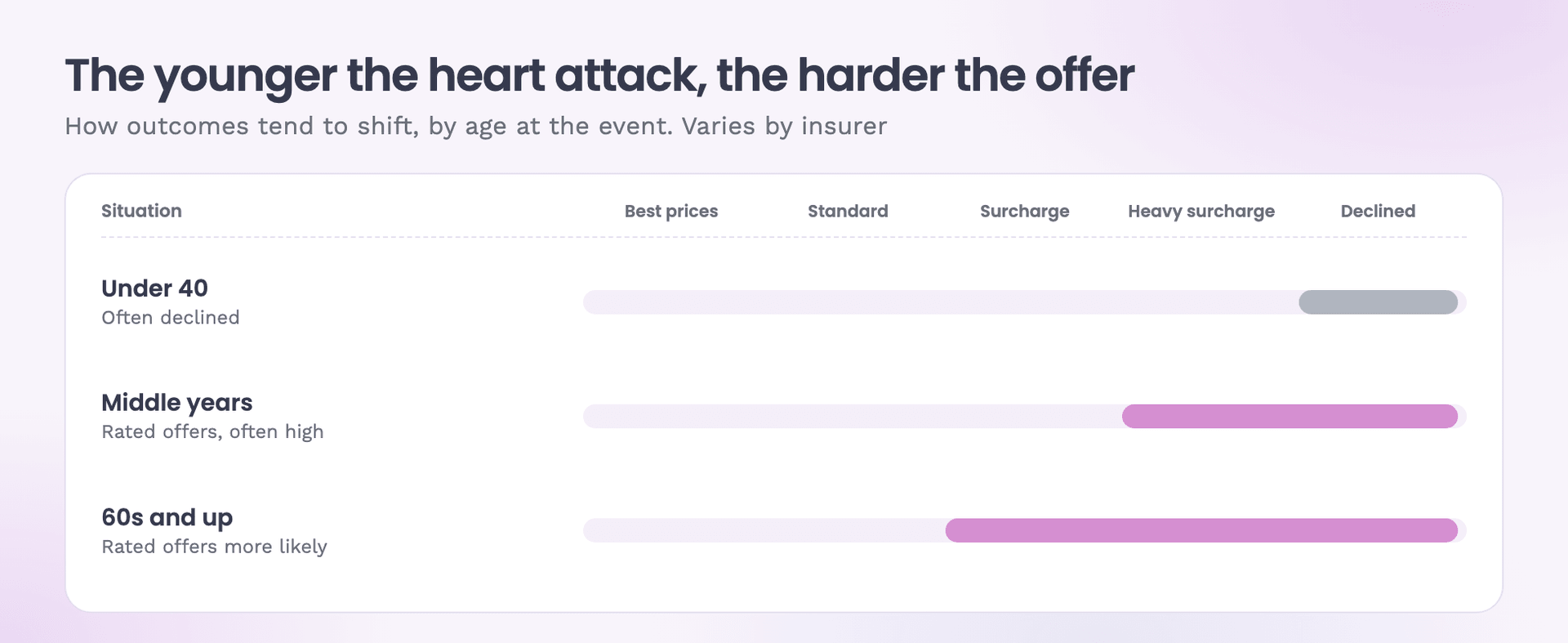
If your event happened young, this can be hard to read. It does not mean every insurer will decline you. Some guides, and some underwriters, look at individual cases more closely, so working with an adviser who can approach several insurers is worth it.
What do insurers look for with heart disease?
"Heart disease" covers very different conditions, and they are priced very differently.
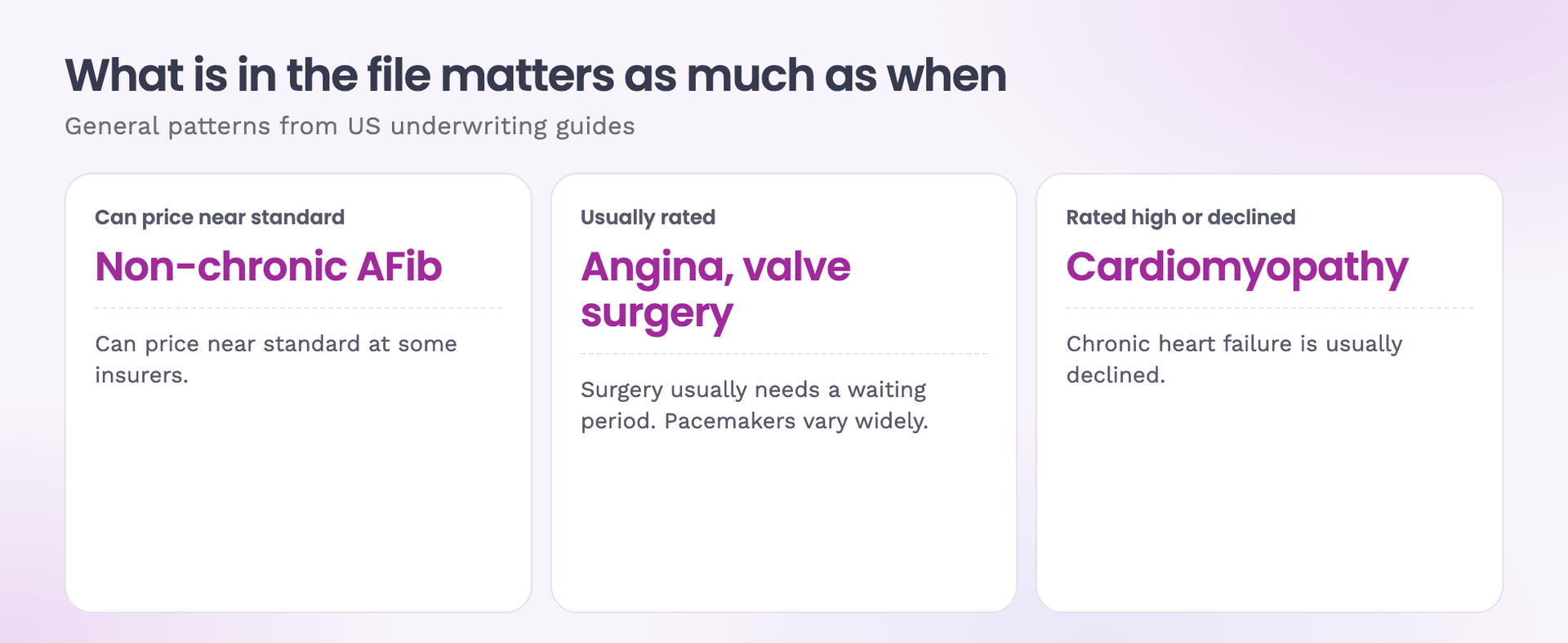
- Atrial fibrillation (an irregular heartbeat): often the most forgiving. At some insurers, a non-chronic case with no underlying heart disease and only short, occasional episodes can price near standard. Chronic cases, or those with other heart disease, are rated higher or declined.
- Heart valve surgery: after the first year, ratings depend on your age and which valve was repaired or replaced.
- Angina (chest pain from reduced blood flow): typically rated rather than declined, with the rating depending on age, whether the angina is stable and what your catheterization report showed. Unstable angina at a younger age is usually declined.
- Cardiomyopathy: priced toward the high end almost everywhere, and sometimes declined.
- Pacemaker: the range is wide. A pacemaker for a conduction problem in an otherwise healthy heart is a very different case from one used with advancing heart failure.
- Chronic heart failure: usually declined.
- Implanted defibrillator: often declined, and most simplified products won't accept it.
Other conditions in your file matter too. Heart disease together with diabetes is usually treated as a higher risk than either alone, and some simplified products switch off when both are present. Your blood pressure, cholesterol, weight and tobacco use all feed into the same picture. If you smoke or recently quit, see when non-smoker rates may apply. A stroke or TIA history is its own category, covered in our stroke and TIA guide.
How can you improve your life insurance offer with heart disease?
You sometimes can. At least one major guide notes that an offer for coronary artery disease may improve with credits for favorable factors, such as well-controlled cholesterol and recent negative cardiac testing. Credits are never guaranteed and vary by insurer. They do show that a heart file is not only its worst page.
Things that can help your file:
- A recent stress test or catheterization with good results.
- Cholesterol and blood pressure that are under control.
- Heart function that has recovered, such as an improved ejection fraction.
- No symptoms or hospital visits since the event.
- A steady medication list and regular follow-up with your cardiologist.
None of this means changing anything about your care. Your treatment plan belongs to you and your doctor. The point is only that good results, written down with dates, give an underwriter something to price.
What types of life insurance work for heart patients?
Fully underwritten policies review your medical records and may include an exam and lab work. For most heart histories, this is the realistic route. It is where age, timing, test results and credits are weighed one case at a time, so your cardiology records can work in your favor.
Simplified and no-exam policies skip the exam but can still ask health questions, and they can check prescription and medical information records. For heart disease, they are narrow:
- Many decline heart disease, coronary artery disease or a stroke outright.
- Some decline heart disease diagnosed within the past year or two, and a few look back as far as 10 years. These often say yes only when the event was long ago and you have had no treatment or heart consultations since.
- Ongoing heart medication usually counts as treatment, so "no treatment since" is a high bar.
- Some decline applicants who take certain blood thinners or heart-rhythm drugs, even when the condition itself is well managed.
- Heart failure and implanted defibrillators are declined by most.
Because of this, an online no-exam application is often not the right fit for a heart history. Eleos offers no-exam term life insurance for most applicants, but a heart history usually needs a licensed adviser and full underwriting, so an online no-exam quote is not the best place to start. If your event was long ago and you have been discharged from cardiology care with no treatment since, an adviser can tell you whether a simpler route is open.
Some insurers offer guaranteed-issue policies with no health questions. These usually have small coverage amounts and a higher price for the amount of coverage, and they often pay a reduced benefit during an early period. They are a fallback, not a first choice.
Do not guess on health questions. If the answers on your application are wrong, the insurer can challenge a claim. Most states allow this for roughly the first two years of a policy, though the rules vary by state.
What to have ready when you apply for life insurance after a heart attack
Underwriters usually ask for similar information about heart conditions:
- The event: the date, what happened and what was found (for example, how many arteries were affected).
- The treatment: stent, bypass, medication only, with dates.
- Heart function: ejection fraction then and now, plus recent stress test or catheterization results.
- Since then: symptoms or none, hospital visits or none, and your current medication list.
- The wider picture: cholesterol, blood pressure, diabetes status, weight and tobacco use.
Questions people ask
Can you get life insurance with heart disease? Sometimes, yes. Timing, your age at the event, the specific condition and your results since all matter. Most cases need full underwriting with medical records.
I had a stent two years ago and feel fine. What should I expect? Usually full underwriting, and most likely a rated offer rather than standard pricing. Your age at the event and your follow-up tests matter most. Two clean years on the record can help, but there is no guarantee.
Can I do anything to improve my offer? You can make sure your records are complete and recent. Test results, controlled cholesterol and blood pressure, and a steady follow-up history may earn credits at some insurers. Keep following your doctor's advice and don't change treatment for an application.
My heart attack was 11 years ago and I take no heart medication. Can I get a simple policy? Possibly. Some simplified products say yes after 10 years with no treatment or consultation since. Read each health question carefully, because they differ on what counts as treatment.
What if I have heart disease and diabetes? Expect a higher rating, or a decline at some insurers. Full underwriting with a good control record for both is usually the better route.
Is it worth applying with a defibrillator? Most standard and simplified products decline it. A licensed adviser can tell you whether any option is realistic, or whether guaranteed-issue coverage is the practical choice.
Does life insurance pay out after a heart attack? Yes, if the policy is in force. A term policy pays its death benefit when you die during the term, whatever the cause, subject to the policy terms. In the first two years or so (the contestable period in most states), the insurer can review the application, so answer every question accurately.
Can I get life insurance with congestive heart failure? It is difficult. The guides we reviewed generally decline heart failure on both underwritten and simplified products. Guaranteed-issue coverage, which asks no health questions, is the option most often left open.
Will my premium go down if my heart health improves? The price of a policy you already own is set when it is issued, so it does not drop on its own. If your results improve and stay improved, you can ask the insurer about reconsideration or compare new quotes, though a new policy is priced at your older age and nothing is guaranteed.
How much coverage do I need? That depends on your debts, income and family, not your diagnosis. Our guide to how much term life insurance you need can help. If you are older, our guide for seniors covers what changes with age.
Can Eleos Life help if you have heart disease?
Yes. Eleos Life helps people with heart disease find life insurance in every US state except New York. We're a licensed insurance producer working with multiple A-rated insurers, so you aren't limited to one insurer's rules. That matters because insurers judge heart disease differently, and one no isn't the last word.
We can help in two ways:
- Fully underwritten coverage: an insurer reviews your full health history. This route offers the highest coverage amounts and the best chance of a fair price. Talk to a licensed adviser at +1 888 998 1020, or start with a quote below.
- Guaranteed-issue coverage: no medical exam and no health questions, if underwritten coverage isn't available. Coverage amounts are lower, a waiting period applies, and availability varies by state.
We can't promise an offer from any one insurer, but we can show you which routes are open to you.
The bottom line
With heart disease, insurers look at timing, your age at the event, the specific condition and your results since. Simplified products are narrow, so most people need full underwriting, and compare more than one insurer. A complete, up-to-date set of records helps, and your cardiologist should guide every treatment decision.
Talk to an adviser or check your options with Eleos. There is no obligation.
This guide describes how life insurance underwriting generally works, based on the underwriting rules of the insurers Eleos works with. It isn't advice and it isn't a quote. Individual outcomes depend on your full application. Figures are indicative and current as of November 2026. Questions about your heart condition and treatment are for your doctor.
Fact-checked and reviewed by Kiruba Shankar Eswaran or another licensed agent on our team. Read our editorial standards.
This guide is for general educational purposes and is not insurance advice. Product features, availability, and amounts vary by state and by policy. Always review the official plan documents for the full terms, limitations, and exclusions before you buy.
Related resources

Life insurance after a DUI: how long insurers look back
A DUI is priced mostly by time since the offense, the number of offenses and license status. This guide explains look-back periods, flat extras and how to choose a route.

Life insurance with sleep apnea: how CPAP use affects your rate
Sleep apnea rarely blocks life insurance. This guide explains how severity and treatment records shape your rate and which application route to consider.

Life insurance with depression and anxiety: how insurers judge severity
How US life insurers sort depression and anxiety into mild, moderate and severe, what moves your price, and how fully underwritten and no-exam routes differ.

Life insurance with asthma: what insurers look at
How US life insurers judge asthma by severity, attacks, treatment and tobacco use, why a COPD label matters, and whether to apply fully underwritten or no-exam.

Life insurance with high cholesterol: the full picture
How high cholesterol and statins affect life insurance: what insurers measure, where their limits sit, and how to get a better price.

Life insurance after cancer: waiting periods and options
Cancer history doesn't automatically rule out life insurance. Insurers look at type and stage, time since treatment, and recurrence or spread, and their waiting periods vary widely.