Life insurance after cancer: waiting periods and options


Short answer: a history of cancer does not automatically rule out life insurance. Your options depend on the type of cancer, how long ago treatment ended, and whether it ever spread or came back. Minor skin cancers are often treated lightly. Most other cancers involve a waiting period, and the length of that wait differs a lot from one insurer to the next.
Life insurance after cancer is often possible, and it's more common than many people think. About 18.6 million Americans, roughly 1 in 18, are living with a history of cancer, according to the American Cancer Society. Many assume they can't get coverage at all. That isn't always true, because insurers don't treat cancer as a simple yes or no.
Underwriters tend to work through three questions: what type of cancer was it, how long ago did treatment end, and has it ever returned or spread? This guide covers each one in plain terms, so you know what to gather before you apply. If you're new to this kind of coverage, start with what term life insurance is.
Can you get life insurance if you've had cancer? Start with the skin cancer exception
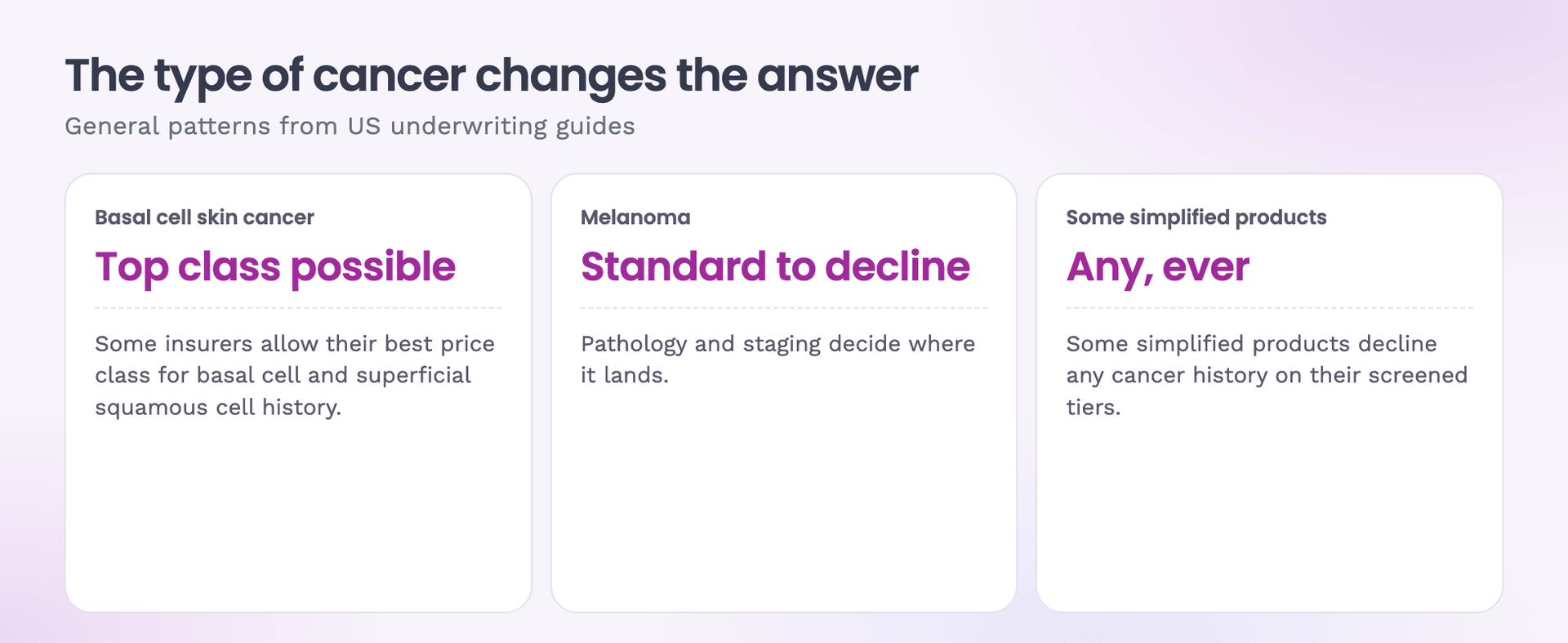
Basal cell carcinoma and superficial squamous cell skin cancer are the most common skin cancers. They are usually removed in a single procedure. Many insurers treat them very differently from other cancers.
In the underwriting guides we reviewed, some insurers allow these skin cancers to qualify for their top price classes. Some simplified products carve them out of their cancer questions by name. Others set them aside from their waiting-period rules entirely. If this is your whole history, you will often be underwritten much like someone with no cancer history, though outcomes still depend on the rest of your application.
Two limits apply:
- Location matters. Squamous cell cancer outside the skin is not covered by this exception.
- Melanoma is different. Insurers price it as a more serious cancer. Outcomes in the guides we reviewed range from standard pricing to a decline, depending on the pathology.
How do type and stage affect life insurance for cancer survivors?
Beyond minor skin cancers, the type and stage of your cancer set the ceiling on what is possible.
Insurers rarely print a single answer for internal cancers, leukemia or lymphoma. Several guides tell their underwriters to review the case individually, looking at the type, the dates of diagnosis and last treatment, and how well treatment worked. Some also say that even a favorable history may stop short of the very best price classes.
Applying for the best classes often requires no history of a life-threatening cancer. Some simplified products take the opposite approach and decline any history of cancer on their screened tiers, however old.
That is why paperwork matters. Two people who both say "breast cancer, five years ago" can get very different offers depending on grade, stage, margins and lymph node findings. Bring the pathology report and treatment summary rather than relying on memory.
How long after cancer can you get life insurance?
Time is the second gate, and each insurer runs its own clock. These ranges are general, not any one insurer's rule:
- Within the last year: some insurers ask their agents to contact underwriting before submitting anything, because the answer may be a decline.
- Fully underwritten insurers: many postpone most cancers for roughly 2 to 5 years after treatment. After that, an underwriter reviews the file. It's not an automatic approval.
- Simplified-issue products: these use a fixed look-back, commonly between 2 and 5 years. Some also decline anyone currently in treatment.
- The strictest products: a few look back 10 years or more.
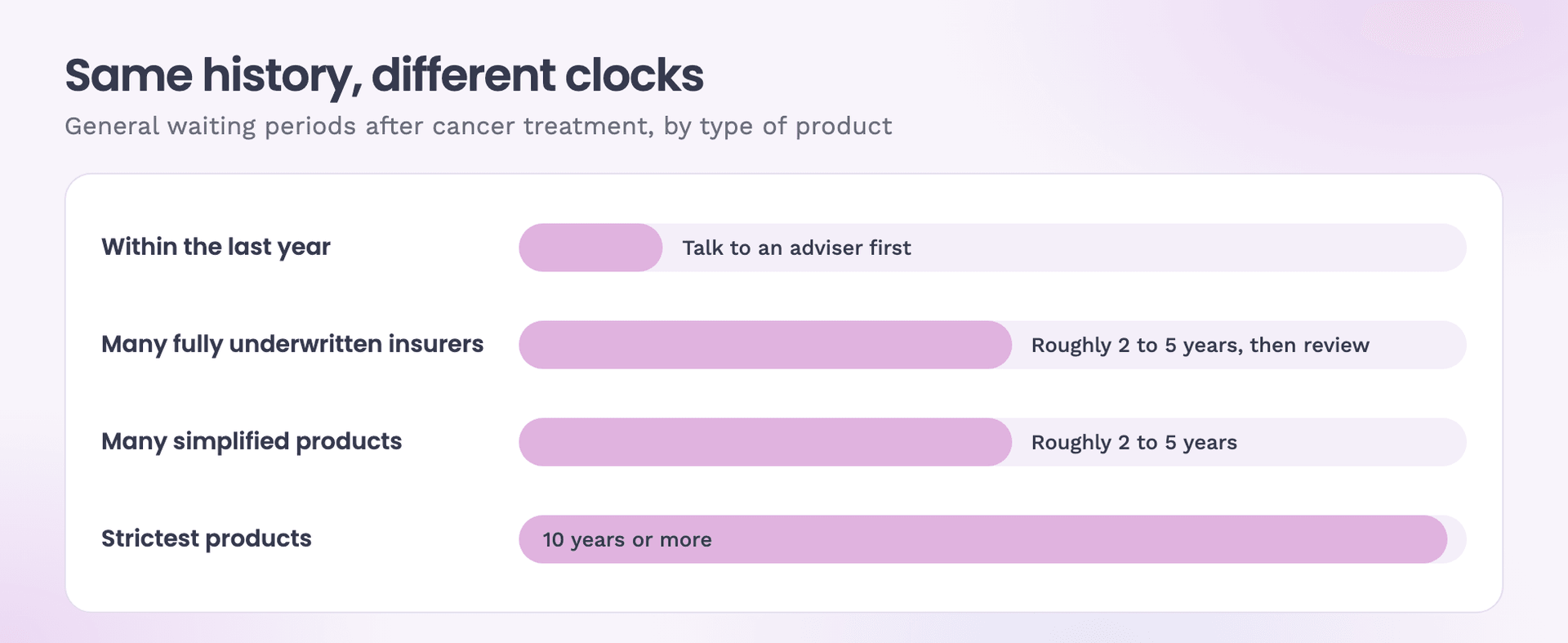
Your years since treatment is a fact. Which insurer's clock it is measured against is a choice. Someone declined at nine years by a 10-year product might be approved elsewhere. Matching your history to the right type of product can matter more than waiting another year.
One more caution. Treatment is often defined broadly. Some guides count a treatment plan, a referral or a prescription as treatment, so ongoing follow-up care may keep a clock from starting. Ask rather than assume.
Does hormone therapy count as treatment?
Many people take hormone therapy for years after breast cancer, often five to 10. Tamoxifen, letrozole and anastrozole are common examples.
Insurers treat these drugs in different ways:
- Some count hormone therapy as treatment, so their waiting period starts only when the prescription ends.
- Some list these drugs on their decline medication lists outright.
- Fully underwritten insurers are more likely to weigh your whole picture, including how long ago the surgery, radiation or chemotherapy ended.
So a person who finished surgery and radiation six years ago may be six years out by their own count, and still be "in treatment" by an insurer's. Before you apply, ask whether the insurer counts your medication as treatment. Medication decisions belong to you and your oncologist. Never change or stop treatment to improve an application.
What if the cancer came back or spread?
Recurrence and spread are the closest thing to a permanent line in cancer underwriting.
Some simplified products decline metastatic cancer, or a recurrence of the same cancer, at any point in the past. At least one fully underwritten insurer asks agents to call before submitting a case with multiple cancers or a recurrence.
Underwriters price a first cancer, fully treated, from long-run survival data. A cancer that has already returned or spread follows a different pattern. Stage 4 or metastatic cancer is the hardest case. Many standard term products decline it, and simplified products generally do too. Some guaranteed-issue plans don't ask health questions, but they have limited benefits and a waiting period. After a recurrence, traditional underwriting with full medical records is usually the more realistic route. Some fully underwritten insurers will review these cases individually, sometimes years later.
What questions will insurers ask about cancer?
Expect questions like these:
- The exact diagnosis and where it started
- The date of surgery or other treatment
- Stage, grade and whether lymph nodes were involved
- Any current treatment and every medication you take
- The date of your last oncology visit, and whether you've been discharged from follow-up or are still being monitored
- Planned follow-up
Having these answers ready makes the process faster, and it lets an underwriter see an old, resolved history for what it is. Cancer history also tends to come up alongside other health factors. Smoking history and conditions such as Crohn's disease or colitis are weighed too. If a diagnosis has also affected your mental health, our guide to depression and anxiety explains how insurers look at that.
Four examples of life insurance after cancer (not quotes)
A removed basal cell skin cancer, two years ago, nothing else. This is often treated very lightly. At some insurers it can still reach top classes.
Stage 1 cancer, surgery only, treatment ended six years ago, no recurrence, no ongoing medication. Fully underwritten insurers may consider this, and a standard price is possible at some. A look-back of 10 years would still exclude it, while a shorter look-back would not.
The same history, but still on hormone therapy. Some insurers treat that as ongoing treatment, and some decline the medication outright. Fully underwritten insurers who weigh the whole file are usually the better place to start.
A cancer that recurred once and has been clear for three years. Simplified products may be closed. Traditional underwriting with full records is the usual route, and a table rating (a surcharge over the standard price) is a realistic outcome.
Fully underwritten vs. no-exam life insurance after cancer
Fully underwritten policies use an application, often a medical exam, and your medical records. For a cancer history, that route can work well if your history is older, well documented and favorable. An underwriter can read the pathology and the follow-up notes instead of reacting to a single checkbox.
Simplified-issue and no-exam policies skip the exam but not the health questions. Cancer is a standard question, usually with a look-back period or a question about current treatment. These products can also check prescription and medical information records, so every answer should be accurate. If you can answer "no" to the cancer questions truthfully, the process is often quick. If you can't, a fully underwritten policy is usually the better fit.
Eleos offers no-exam term life insurance, with an online application that takes about 15 minutes and no medical exam for most applicants. The online quote suits a history of basal cell or superficial squamous cell skin cancer. For any other cancer, talking to an adviser first is usually the better start.
Whichever route you take, accuracy matters. Most policies have a contestable period, generally the first two years (it varies by state), when the insurer can review the application if a claim is made. A material misstatement about your health can lead to a denied claim, so answer every question completely.
Questions people ask
How long after cancer can I get life insurance? It depends on the insurer, the type and the stage. Minor skin cancers often have no wait. For other cancers, many fully underwritten insurers look at cases from roughly 2 to 5 years after treatment, and some simplified products look back 10 years. The same history can get different answers at different companies.
Can you get life insurance with stage 4 cancer, or while in treatment? It is difficult. Insurers commonly decline metastatic cancer, and several simplified products decline anyone currently in treatment. Underwriters may review a case individually, but no outcome is certain. If underwritten coverage isn't available, guaranteed-issue term life with no health questions may be an option. Talk to an adviser about what fits.
Does "in remission" satisfy insurers? Insurers work from dates, pathology and medication lists. "Treatment ended in March 2021, no recurrence, discharged from oncology follow-up" is a much more useful answer than "in remission."
I'm on hormone therapy. Do I have to wait until it ends? Not necessarily, but insurers differ. Some count it as treatment and some decline the medication. Ask before you apply. Treatment decisions are for you and your doctor.
What about a benign tumor? Benign tumors are often rated standard at fully underwritten insurers, but some simplified products ask about any doctor-diagnosed tumor, benign or not.
What if you have a family history of cancer? Family history is asked about separately. It mostly matters for the best price classes at some insurers, and it is not the gate your own history is.
How much coverage should I get? That depends on your debts, income and family, not your diagnosis. Our guide to how much term life insurance you need walks through it. Many survivors are in their 60s or older, so our guide to term life insurance for seniors may also help.
Can Eleos Life help if you've had cancer?
Yes. Eleos Life helps people with a cancer history find life insurance in every US state except New York. We're a licensed insurance producer working with multiple A-rated insurers, so you aren't limited to one insurer's rules. That matters because insurers judge a cancer history differently, and one no isn't the last word.
We can help in two ways:
- Fully underwritten coverage: an insurer reviews your full health history. This route offers the highest coverage amounts and the best chance of a fair price. Talk to a licensed adviser at +1 888 998 1020, or start with a quote below.
- Guaranteed-issue coverage: no medical exam and no health questions, if underwritten coverage isn't available. Coverage amounts are lower, a waiting period applies, and availability varies by state.
We can't promise an offer from any one insurer, but we can show you which routes are open to you.

The bottom line
Cancer underwriting comes down to three questions: type and stage, the real end date of treatment, and whether the cancer ever returned or spread. Waiting periods run from none for minor skin cancers to 10 years or more at the strictest products, and no two insurers agree. Gather your pathology report and treatment dates, and compare more than one insurer before you accept a decline or a surcharge.
Check your options. A skin cancer history can start with an online quote. For any other cancer, talk to an adviser first. There is no obligation.
This guide describes how life insurance underwriting generally works, based on the underwriting rules of the insurers Eleos works with. It isn't advice and it isn't a quote. Individual outcomes depend on your full application. Figures are indicative and current as of November 2026. Questions about your diagnosis, treatment or medication are for your doctor.
Fact-checked and reviewed by Kiruba Shankar Eswaran or another licensed agent on our team. Read our editorial standards.
This guide is for general educational purposes and is not insurance advice. Product features, availability, and amounts vary by state and by policy. Always review the official plan documents for the full terms, limitations, and exclusions before you buy.
Related resources

Life insurance after a DUI: how long insurers look back
A DUI is priced mostly by time since the offense, the number of offenses and license status. This guide explains look-back periods, flat extras and how to choose a route.

Life insurance with sleep apnea: how CPAP use affects your rate
Sleep apnea rarely blocks life insurance. This guide explains how severity and treatment records shape your rate and which application route to consider.

Life insurance with depression and anxiety: how insurers judge severity
How US life insurers sort depression and anxiety into mild, moderate and severe, what moves your price, and how fully underwritten and no-exam routes differ.

Life insurance with asthma: what insurers look at
How US life insurers judge asthma by severity, attacks, treatment and tobacco use, why a COPD label matters, and whether to apply fully underwritten or no-exam.

Life insurance with high cholesterol: the full picture
How high cholesterol and statins affect life insurance: what insurers measure, where their limits sit, and how to get a better price.