Life insurance with Crohn's disease or ulcerative colitis


Short answer: you can often get life insurance with Crohn's disease or ulcerative colitis, but the answer depends on the insurer. Underwriters look at when you were diagnosed, how severe the disease is, how long it has been stable, whether you have had surgery, and which medications you take. Some insurers price these conditions case by case. Others decline certain cases outright, so one file can get very different answers.
Life insurance with Crohn's disease or ulcerative colitis is possible, but the process looks different from a standard application. These are the two main forms of inflammatory bowel disease (IBD). The CDC estimates that about 4.1 million US adults have been diagnosed with IBD, roughly 3.1 million with ulcerative colitis and 1.3 million with Crohn's. Many of them assume life insurance is out of reach. For many people, it isn't.
Two facts surprise most applicants. Some insurers set an age-at-diagnosis rule for Crohn's. And at some no-exam insurers, a medication you take can lead to a decline even when your disease is well controlled. This guide explains how insurers think about both, so you can read your own file the way an underwriter will. If you're new to this type of coverage, start with what term life insurance is.
What questions will insurers ask about Crohn's or colitis?
For IBD, insurers tend to ask the same few questions:
- When were you diagnosed, and how old were you? A recent diagnosis is an unknown. Nobody can yet say whether the disease will stay mild.
- How severe is it? Mild, moderate and severe cases are treated very differently.
- How long has it been stable? Time since your last major flare, and since your diagnosis, both count.
- Have you had surgery or been hospitalized? A bowel resection or an ostomy points to more active disease. One surgery long ago, followed by years of stability, reads differently from recent surgery.
- What are you taking? Medication tells an underwriter how active the disease has been, and some no-exam products screen on the drug itself.
- How is your general health? Unintended weight loss, anemia or poor nutrition in the record can suggest the disease is not well controlled. Our guide to how weight and BMI affect term life rates covers that side.
Many insurers also want your doctor's records for IBD. Some require an attending physician statement for these conditions after you have seen a doctor about them, regardless of your age or the amount of coverage. That makes your gastroenterologist's notes the record that counts. Your own description of your disease is not the document of record.
How do Crohn's and colitis affect life insurance rates?
Fully underwritten insurers review your medical records and sometimes ask for an exam. Their guides rate IBD on severity and time. Three patterns show up across them.
Time matters most for Crohn's. Some insurers decline a new Crohn's diagnosis until it has been a certain length of time. The wait is shorter for very mild disease, often months, and longer for moderate or severe disease, from a couple of years to four or more. After that, mild cases can be priced from standard up to a modest surcharge. Moderate cases are usually rated, and severe cases are rated heavily or declined.
Age at diagnosis can matter. At least one insurer declines Crohn's that began before the mid-20s. Ulcerative colitis in the same guide has no such age rule. Another insurer prices Crohn's across a wide range, from standard to a heavy surcharge, with no age gate in its guide. That's why a person diagnosed at 19 who has been mild for ten years can be declined at one company and quoted at another.
Ulcerative colitis is judged mainly on severity. At some insurers, mild colitis can reach standard prices or a light surcharge, moderate colitis lands at a heavier rating, and severe colitis or colitis with complications is declined. Others start every colitis case with a surcharge, even for mild disease. Many also look for a year or more since diagnosis or since a major flare.
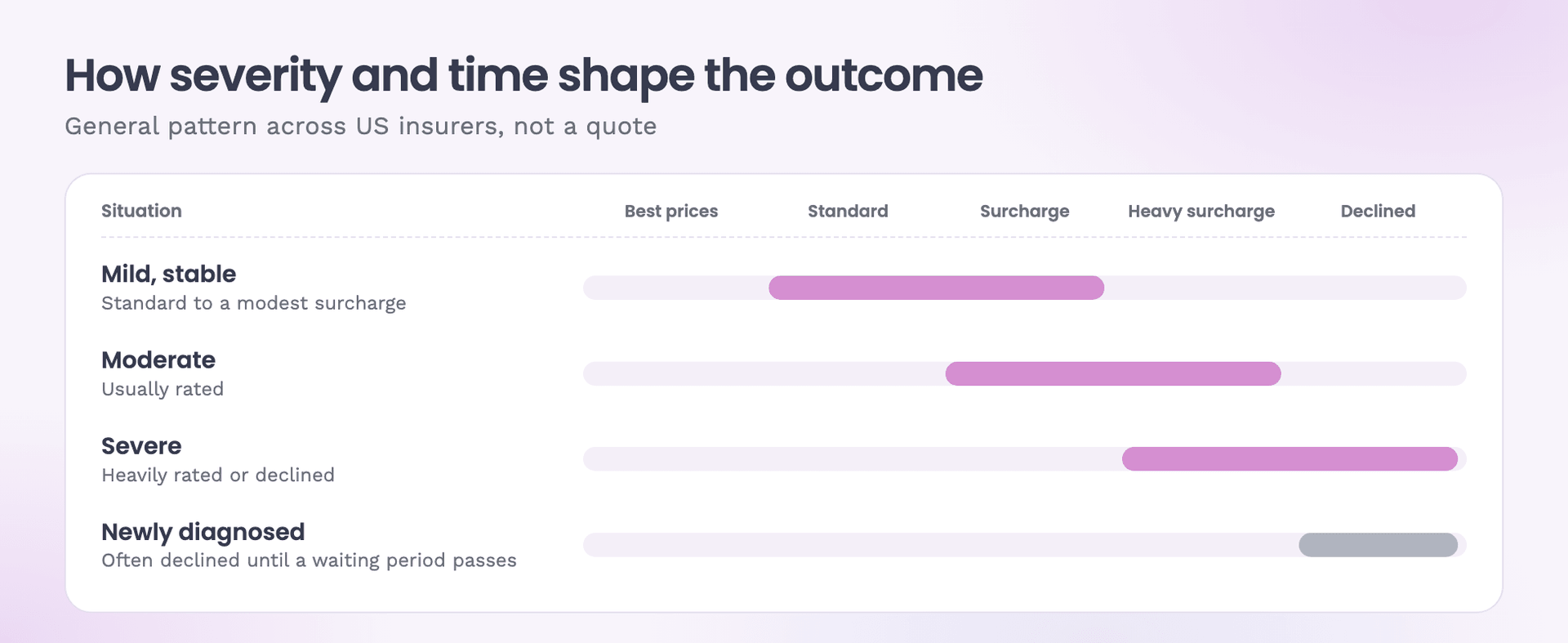
In this context, a table rating is a surcharge on the standard price. Each table step adds roughly 25 percent. So Table 4 is about double the standard price, and Table 8 is about triple. Not every case is rated that high, and a rated offer from one insurer is not a verdict. It is one company's reading of its own guide.
"Controlled with medication" carries a lot of weight in these guides. Colitis that needs little treatment and colitis held down by stronger therapy are very different risks, even though both are "ulcerative colitis" on a form. Your medication history is how an underwriter tells them apart.
Does your medication affect life insurance with Crohn's or colitis?
This is the part most applicants don't expect. Many no-exam products can't review a full medical file, so they screen on proxies. One of those proxies is a list of medications. If you take a drug on the list, the application may be declined, whatever the drug is prescribed for.
Drugs such as methotrexate and adalimumab (Humira) appear on lists like this at some insurers. They are used for several conditions, including IBD. If your disease is well controlled on one of them, the disease itself may pass while the prescription does not.
This isn't a judgment of you. Biologics and immunosuppressants are on these lists because, across all the conditions they treat, they often go with more serious disease. People whose condition is well controlled get caught by a rule designed for a different group.
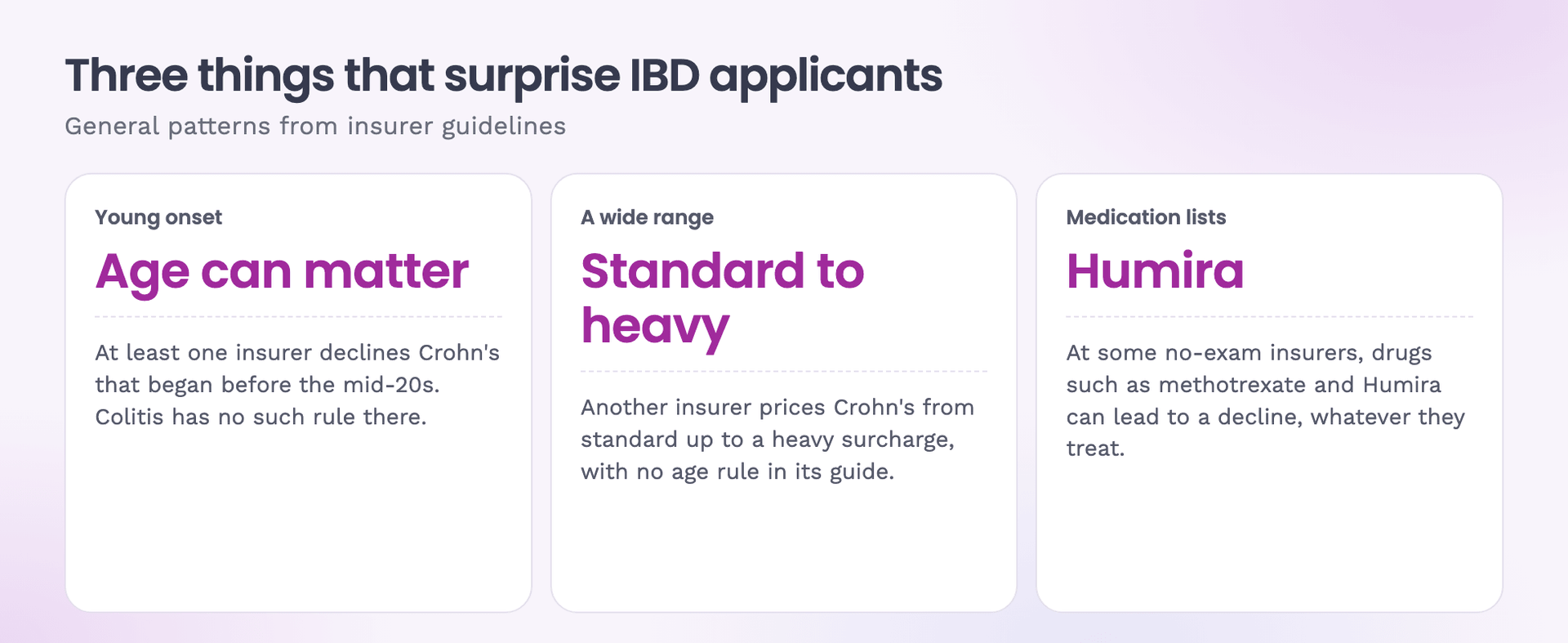
Other no-exam products work differently. Some name Crohn's and colitis directly and decline them. Some don't ask about IBD by name, so your answer depends on the rest of their questions and on the medication list. Because every product differs, ask before you apply: is my medication on your list, whatever the diagnosis? Never stop or change a medication to improve an application. Medication decisions belong with your doctor.
Can you get life insurance with Crohn's disease or ulcerative colitis? Your options
Fully underwritten policies involve your medical records and sometimes an exam. This is where the severity and time ranges above apply. A person reads the file and can see well-controlled disease behind the prescription, so this route is often the better fit if you take a biologic or an immunosuppressant.
Simplified issue and no-exam policies ask health questions instead of requiring an exam. They can still ask about your conditions and medications, and they can check prescription and MIB (Medical Information Bureau) records, so answer every question accurately. In general, a misstatement can give the insurer grounds to contest a claim, usually during the first two years of the policy, though the rules vary by state.
A rough guide to routes:
- Mild, stable, minimal medication: compare fully underwritten options through an adviser. Outcomes can differ a lot between insurers.
- On a biologic or immunosuppressant: check the medication question first. Fully underwritten coverage is often the more reliable market.
- Recently diagnosed: many fully underwritten insurers will want to wait. A no-exam product may be available sooner if it accepts your condition, so check its medication list and health questions first. You can look at replacing it later, and your existing policy should stay in force until a new one is approved.
- Severe or complicated history: expect ratings at best in the fully underwritten market, and treat any standard-price quote with caution until it survives the review of your records.
- Diagnosed young: a decline at one insurer may reflect that insurer's age rule. It doesn't mean every insurer will say no. See also our guide to life insurance for young adults.
Eleos offers no-exam term life insurance, but for Crohn's and colitis the online quote may not be the right place to start. No-exam routes often decline these conditions, and no-exam doesn't mean no health questions. Talking to an adviser first usually makes more sense.
How to prepare your application
You can't change your history, but you can make it easy to read.
- Know your facts. Diagnosis date, age at diagnosis, flare dates, hospital stays, surgeries and current medications.
- Ask for a copy of your records and check that dates and details are correct. If you find a mistake, ask your doctor's office how to correct it.
- Show stability. Time without major flares, and a steady treatment plan, are the strongest points in an IBD file.
- Check the other factors. Tobacco use is priced separately and can add a lot to the cost, and smoking can also affect Crohn's. If you've stopped, see when non-smoker rates may apply.
- Think about other conditions. If you also manage something like depression or anxiety or have a cancer history, each condition gets its own assessment.
- Compare more than one insurer. For IBD, the rulebook can matter as much as the medical facts.
Questions people ask
Does remission help? It can, as evidence. Dated records, a stable medication history and your doctor's note describing remission carry more weight than a self-description. Recent flares in the chart will still count.
I had my colon removed for ulcerative colitis. What happens? Insurers can treat this case by case. Bring complete surgical records, including the date, the type of surgery and any complications, and expect an individual review rather than a printed answer.
I was diagnosed with Crohn's at 19 and have been mild for a decade. Why was I declined? It may be an age-at-diagnosis rule at that insurer. Other insurers price Crohn's without that rule, so it's worth comparing more than one.
Can I get life insurance with ulcerative colitis? Often, yes. Mild, stable colitis can be priced from standard up to a surcharge at some insurers, while severe colitis or colitis with complications is declined at some. Time since diagnosis or your last major flare also matters.
Do insurers care which biologic I take? Fully underwritten insurers care mostly about control: how long the disease has been stable on your treatment. Some no-exam products care whether the drug is on their list.
What about IBS? Irritable bowel syndrome (IBS) is a different condition from IBD, and the guides we reviewed generally treat it much more lightly. If your records mix up the two, ask your doctor's office to review them before you apply.
How much coverage should I get? That depends on your debts, income and family. Our guide to how much term life insurance you need walks through it by life stage.
Can Eleos Life help if you have Crohn's or colitis?
Yes. Eleos Life helps people with Crohn's disease or ulcerative colitis find life insurance in every US state except New York. We're a licensed insurance producer working with multiple A-rated insurers, so you aren't limited to one insurer's rules. That matters because insurers judge Crohn's disease or ulcerative colitis differently, and one no isn't the last word.
We can help in two ways:
- Fully underwritten coverage: an insurer reviews your full health history. This route offers the highest coverage amounts and the best chance of a fair price. Talk to a licensed adviser at +1 888 998 1020, or start with a quote below.
- Guaranteed-issue coverage: no medical exam and no health questions, if underwritten coverage isn't available. Coverage amounts are lower, a waiting period applies, and availability varies by state.
We can't promise an offer from any one insurer, but we can show you which routes are open to you.

The bottom line
Crohn's disease and ulcerative colitis can be insured, but the outcome depends on your diagnosis date, severity, stability, history and medications, and on which insurer's rules you meet. Know your facts, check the medication question before you apply, and compare more than one insurer, so your condition doesn't become the reason your family goes without coverage.
Check your options, or talk to an adviser. There's no obligation.
This guide describes how life insurance underwriting generally works, based on the underwriting guidelines of the insurers Eleos works with. It isn't advice and it isn't a quote. Individual outcomes depend on your full application. Figures are indicative and current as of November 2026. Questions about your condition and your treatment are for your doctor.
Fact-checked and reviewed by Kiruba Shankar Eswaran or another licensed agent on our team. Read our editorial standards.
This guide is for general educational purposes and is not insurance advice. Product features, availability, and amounts vary by state and by policy. Always review the official plan documents for the full terms, limitations, and exclusions before you buy.
Related resources

Life insurance after a DUI: how long insurers look back
A DUI is priced mostly by time since the offense, the number of offenses and license status. This guide explains look-back periods, flat extras and how to choose a route.

Life insurance with sleep apnea: how CPAP use affects your rate
Sleep apnea rarely blocks life insurance. This guide explains how severity and treatment records shape your rate and which application route to consider.

Life insurance with depression and anxiety: how insurers judge severity
How US life insurers sort depression and anxiety into mild, moderate and severe, what moves your price, and how fully underwritten and no-exam routes differ.

Life insurance with asthma: what insurers look at
How US life insurers judge asthma by severity, attacks, treatment and tobacco use, why a COPD label matters, and whether to apply fully underwritten or no-exam.

Life insurance with high cholesterol: the full picture
How high cholesterol and statins affect life insurance: what insurers measure, where their limits sit, and how to get a better price.

Life insurance after cancer: waiting periods and options
Cancer history doesn't automatically rule out life insurance. Insurers look at type and stage, time since treatment, and recurrence or spread, and their waiting periods vary widely.