Life insurance with epilepsy: what insurers look at


Short answer: you can often get life insurance with epilepsy, but it depends on how recently you were diagnosed, how long you have been seizure-free, what type of seizures you have and how well they are controlled. New diagnoses are usually postponed or declined. A long, well-controlled history can be priced at standard rates or a modest surcharge at some insurers.
Life insurance with epilepsy is more available than many people expect. About 3 million US adults have active epilepsy, according to the CDC. Many assume it means an automatic decline. For people with a long, stable history, that is often not the case. For people with a recent diagnosis or frequent seizures, the answer is usually "not yet" or a high price.
Insurers do not price epilepsy with one number the way they price a cholesterol reading. They look at a handful of facts: how long ago you were diagnosed, when your last seizure was, what type of seizure you have, how many you have per year, and how your treatment is working. This guide explains how those facts are weighed and how to prepare. If you're new to this type of coverage, start with what term life insurance is.
The insurance rules below come from the underwriting guides of several US insurers, explained here in general terms. Details differ by company, and no outcome is guaranteed.
Can you get life insurance with epilepsy?
For epilepsy, the most useful fact in your file is the date of your last seizure. The longer ago it was, the better your options usually look. Underwriters are looking for a stable pattern, and time is how they see one.
The milestones in the guides we reviewed fall into three stretches:
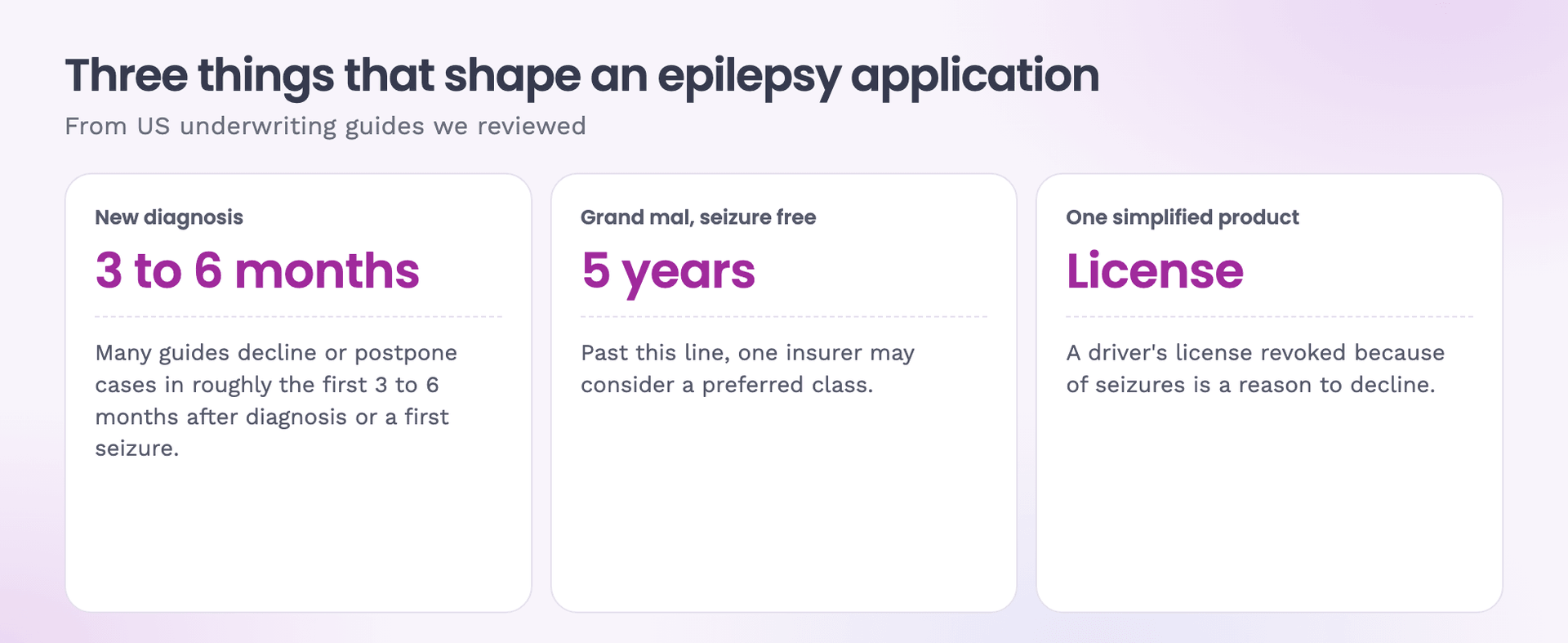
- The first months after diagnosis. Many guides decline or postpone, and the waiting period is often about 3 to 6 months. Some start the clock at the diagnosis and some at the first seizure. One guide postpones for a shorter time when the cause is known than when it is unknown.
- About two seizure-free years. This is the point where several guides describe "well controlled" cases, which can be priced at standard rates or a modest surcharge.
- Five years or more. One guide says a preferred class may be possible for generalized convulsive seizures when the last seizure was more than five years ago. That is an exception, not a rule across the market.
A newly diagnosed seizure disorder is an unfinished story to an insurer. The cause may not be settled, medication may still be changing, and nobody yet knows how often seizures will happen. Waiting lets the pattern show itself. If you were diagnosed recently, that is a good time to talk with your neurologist and keep good records. Whether and when to apply is your call, and your treatment plan is a matter for you and your doctor.
Does seizure type change your rates?
Epilepsy is not one thing, and several guides price it by seizure type. You may see two older terms:
- Absence seizures (formerly "petit mal") are brief lapses in awareness, often a few seconds of staring.
- Generalized tonic-clonic seizures (formerly "grand mal") involve stiffening and jerking and loss of consciousness.
Some guides still use the old terms, so your file may too. The Epilepsy Foundation explains how the older and newer names line up. One more point on terminology: doctors usually diagnose epilepsy after at least two unprovoked seizures, or after one when the risk of more is high. A single seizure with a clear, treated cause is a different situation from epilepsy.
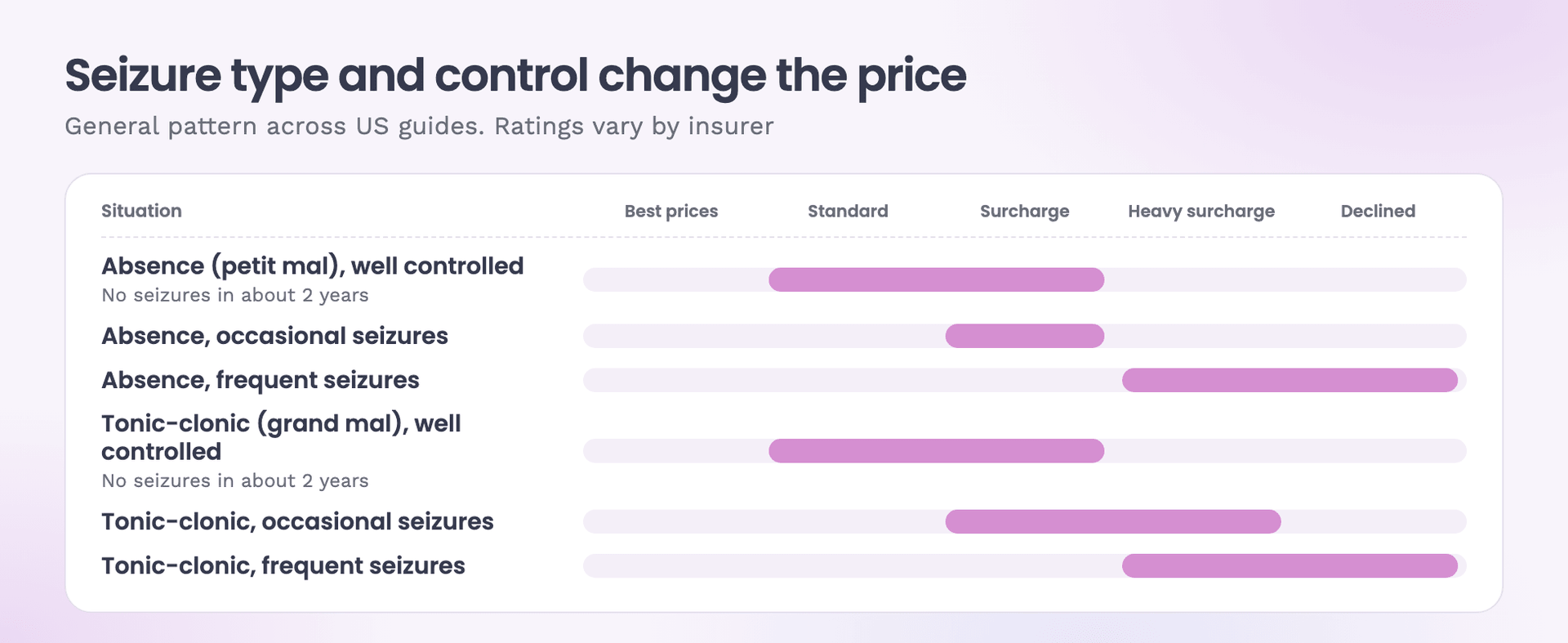
Across the guides, three things push a rating up:
- Frequency. How many seizures you have a year matters a lot, and a small difference in count can land on either side of a line.
- Severity. Long periods of unconsciousness or repeated hospital stays count against you.
- Treatment. One medication that holds seizures at bay reads as control. Several medications with breakthrough seizures read as a harder case.
At moderate control, the same seizure count can be priced a few steps apart depending on type, with absence seizures usually on the milder side. At poor control, both types can run to the highest ratings or a decline. Not every insurer splits by type. Some simply give epilepsy a wide range of possible ratings, with the result decided case by case. That is one reason where you apply matters.
How does epilepsy affect life insurance rates?
Insurers sort applicants into price classes, then add table ratings for health conditions. Each table step adds roughly 25 percent to the standard price. Table 2 means about 50 percent more and Table 4 about double.
A quick illustration, not a quote. If standard pricing for a policy is $50 a month, Table 2 is about $75 and Table 4 is about $100. Epilepsy can put you anywhere from standard to a high table, or a decline, depending on the factors above.
Does your driver's license matter?
Some insurers ask about your driver's license in epilepsy cases. One simplified product treats a license revoked because of seizures as a reason to decline. This makes sense because states have their own rules for driving after a seizure. There is no federal rule. Most states require a seizure-free period, commonly in the range of 3 to 12 months, with some exceptions and medical review.
So a valid license can support the picture of good control, and a revoked one can work against it. If your license was suspended and later reinstated, keep the paperwork. The dates can help show your seizure-free time. This is only one factor among many.
Types of life insurance with epilepsy: simplified and no-exam
Simplified and no-exam products ask health questions instead of requiring an exam. They can still check prescription and MIB records, so answer every question honestly. For epilepsy, these products are often tighter, and rules vary a lot:
- Some ask directly about seizures or epilepsy a doctor has ever diagnosed or treated, and a yes ends the application.
- Some decline only recent cases, for example a seizure in the past 6 months, a diagnosis in the past 6 months, or a revoked license.
- Some list neurological conditions among their exclusions, so epilepsy may or may not be covered by the wording. Read each question carefully.
- At least one insurer excludes seizure disorders from its fast-track program, which skips the paramedical exam.
Many people with epilepsy still do best with a fully underwritten application, which lets the underwriter see your full records and your time since your last seizure.
Which route should you take?
- Epilepsy is usually an adviser-first case. No-exam routes often decline or postpone epilepsy, and a fully underwritten application lets the underwriter see your records and time since your last seizure. A licensed adviser can point you to insurers whose rules suit your seizure type and history.
- Recently diagnosed or recent seizures? Many applications will be postponed or declined for now. An online quote may work once you are past an insurer's waiting period.
- Want to compare? Quotes from more than one insurer are worthwhile. A rating from one company is that company's reading of its own guide, not a verdict on you.
Eleos offers no-exam term life insurance online, but your answers on any application decide what is offered, and health questions about epilepsy are likely to apply.
What insurers ask about your epilepsy, and how to prepare
- Know your dates. Date of diagnosis and date of last seizure, from your medical records rather than memory.
- Get the type in writing. Make sure your records name the seizure type accurately, in your neurologist's words.
- Know your counts. Seizures in the past year and the trend over a few years.
- Be ready to describe treatment. Your medications, doses and how long you have been on them. Medication decisions belong with your doctor. Never change or stop treatment to look better on an application.
- Gather any cause. If a cause was found and treated, such as a head injury, a surgically treated lesion or a metabolic problem, that can matter.
- Keep license records. If your license was suspended and reinstated, bring proof.
- Mention related conditions honestly. Epilepsy often goes along with depression or anxiety, and underwriters read the whole file. If you have had a stroke or TIA, see our guide to life insurance after a stroke or TIA.
Questions people ask
I have been seizure-free for six years. What should I expect? That is often the strongest epilepsy history. Fully underwritten insurers may price a well-controlled case at standard or a modest surcharge, and at least one guide allows a preferred class to be considered for generalized convulsive seizures after five years. Expect the underwriter to ask for your neurology records.
My child has absence seizures. Is that priced like epilepsy? Yes, it counts as epilepsy, but absence seizures are often treated more favorably than convulsive ones. One guide has no postponement period for absence seizures. Accurate wording in the medical record helps. If you are looking at coverage for a young adult, see our guide to life insurance for young adults.
I had one seizure years ago and nothing since. Where do I stand? It depends on the cause and on what testing found. A single seizure with a known, treated cause is usually viewed differently from an unexplained one. Provide your records and expect questions.
Do I need to disclose seizures if I am controlled and off medication? Yes. Applications ask about diagnosis and treatment history, and insurers can check records. In the US, an insurer can generally review a policy for material misstatements during a contestable period, typically two years, though the rules vary by state. Honest answers protect your family's claim.
I lost my license after a seizure and got it back. Does that still hurt? It becomes part of your timeline rather than a final answer. The reinstatement date can support your seizure-free interval, so keep the paperwork.
What is the best life insurance with epilepsy? There isn't one answer. Insurers weigh epilepsy differently, so the best fit depends on your seizure type, seizure-free time and control. Comparing several insurers, ideally through an adviser, is the most reliable way to find a fair price.
Can I get life insurance with epilepsy and no health questions? Guaranteed-issue policies ask no health questions and need no exam, so epilepsy doesn't affect eligibility. Benefits are small, and there is usually a waiting period before the full death benefit applies. Guaranteed-issue is a fallback when underwritten coverage isn't available.
How much coverage should I get? That depends on your debts, income and family, not your diagnosis. Our guide to how much term life insurance you need walks through it by life stage.
Can Eleos Life help if you have epilepsy?
Yes. Eleos Life helps people with epilepsy find life insurance in every US state except New York. We're a licensed insurance producer working with multiple A-rated insurers, so you aren't limited to one insurer's rules. That matters because insurers judge epilepsy differently, and one no isn't the last word.
We can help in two ways:
- Fully underwritten coverage: an insurer reviews your full health history. This route offers the highest coverage amounts and the best chance of a fair price. Talk to a licensed adviser at +1 888 998 1020, or start with a quote below.
- Guaranteed-issue coverage: no medical exam and no health questions, if underwritten coverage isn't available. Coverage amounts are lower, a waiting period applies, and availability varies by state.
We can't promise an offer from any one insurer, but we can show you which routes are open to you.

The bottom line
Epilepsy is priced on seizure-free time, seizure type, control and how well your treatment is working. The first months after diagnosis are usually the hardest, and the picture often improves as seizure-free time builds. Know your dates, get your seizure type documented, keep good records and compare more than one insurer.
Talk to an Eleos adviser first, or check your options with an online quote. There is no obligation.
This guide describes how life insurance underwriting generally works, based on the underwriting rules of the insurers Eleos works with. It isn't advice and it isn't a quote. Individual outcomes depend on your full application. Figures are indicative and current as of November 2026. Questions about your seizures and treatment are matters for your doctor.
Fact-checked and reviewed by Kiruba Shankar Eswaran or another licensed agent on our team. Read our editorial standards.
This guide is for general educational purposes and is not insurance advice. Product features, availability, and amounts vary by state and by policy. Always review the official plan documents for the full terms, limitations, and exclusions before you buy.
Related resources

Life insurance after a DUI: how long insurers look back
A DUI is priced mostly by time since the offense, the number of offenses and license status. This guide explains look-back periods, flat extras and how to choose a route.

Life insurance with sleep apnea: how CPAP use affects your rate
Sleep apnea rarely blocks life insurance. This guide explains how severity and treatment records shape your rate and which application route to consider.

Life insurance with depression and anxiety: how insurers judge severity
How US life insurers sort depression and anxiety into mild, moderate and severe, what moves your price, and how fully underwritten and no-exam routes differ.

Life insurance with asthma: what insurers look at
How US life insurers judge asthma by severity, attacks, treatment and tobacco use, why a COPD label matters, and whether to apply fully underwritten or no-exam.

Life insurance with high cholesterol: the full picture
How high cholesterol and statins affect life insurance: what insurers measure, where their limits sit, and how to get a better price.

Life insurance after cancer: waiting periods and options
Cancer history doesn't automatically rule out life insurance. Insurers look at type and stage, time since treatment, and recurrence or spread, and their waiting periods vary widely.